
AGV Steel Chassis Fabrication: S355JR, NM400 and Load Parameters
A 30-ton AGV steel chassis does not fail because the steel is weak. It fails because the plate grades, welded joints and machined mounting faces do not line up with the way the load actually travels. This guide works through the material and design parameters behind a heavy AGV platform, using the PSA-1 chassis (15 m x 2.7 m x 3 m, 10.5 tons dead weight, 30-ton load capacity) as the reference build, with 25 mm S355JR or A572 Grade 50 structural plate and 20 mm NM400 abrasion-resistant plate carrying different jobs on the same frame.
The article covers what each plate grade is asked to do, how the fabrication sequence turns those plates into a moving platform, and which tolerances have to survive welding before a container or tank load is ever lowered onto the deck.
What Makes a 30-Ton AGV Chassis Different from a Trailer Frame
A trailer frame is usually built around a single, predictable load path: the load sits over the axles and the frame only has to bridge a short span. An AGV chassis rated for 30 tons across a 15 m length has a different problem — the load can sit anywhere along the deck, and the frame still has to keep every wheel pair loaded evenly.
Three failure modes appear on heavy AGV chassis long before a visible crack does:
- Uneven wheel load from longitudinal deflection. A 15 m frame that has not been welded and machined to control straightness will bend in the middle. The centre wheels then carry more load than the end wheels, and the suspension or steering system starts compensating for a defect that should have been machined out at the bench.
- Abrasive wear at contact points. Containers, skid bases and tank saddles land on the deck repeatedly. Structural plate at these interfaces wears, thins and eventually changes the geometry of the locating points.
- Distorted mounting interfaces. Bolt patterns and hinge ears that shift during welding force field assembly to shim or ream, and a shimmed interface is an invitation to fatigue.
The material answer to these three problems is not a single plate. It is a split: structural plate where the frame carries bending, abrasion-resistant plate where the frame carries sliding contact, and a machining step that restores the geometry after welding has moved it.
Why Heavy AGV Demand Is Pulling Sheet Metal Fabrication Toward Thick-Plate Work
Container terminals, steel mills and large logistics yards are replacing fixed conveyors and tractor-trailer moves with automated guided vehicles that work through the day and night. In Singapore, a container-yard AGV program runs 24/7 under heavy and large loads, and the steel chassis on those vehicles are part of that operating rhythm. On the equipment side, the Dutch large-AGV program relies on chassis built to sit under ocean containers and other large objects for a design life beyond 30 years, with the units delivered by Openex now logged at more than four years of stable operation.
The market context behind that shift is large. Grand View Research puts the global sheet metal market at USD 181.8 billion in 2024, projected to reach USD 272.3 billion by 2030. Steel remains the dominant material in the sheet metal segment, holding more than 81% revenue share. In practical terms, most heavy AGV chassis are still steel builds — and as the vehicles get larger, the fabrication work moves from 1.5–5 mm cabinet sheet to 20–25 mm plate with full-penetration welds and post-weld machining.
One standards note matters for buyers here. AWS D9.1/D9.1M:2026, the code for non-structural sheet metal welding, applies to thicknesses up to 3 gauge or 0.250 in (6.4 mm). A 25 mm chassis plate is well outside that scope, so the welding procedure on a heavy AGV chassis has to be written as structural welding with its own WPS, procedure qualification and welder qualification — not carried over from the sheet metal shop's cabinet work.
Material and Load Parameters for the PSA-1 AGV Chassis

Painted AGV steel chassis — PSA-1 class platform, 15 m x 2.7 m x 3 m, 10.5-ton dead weight, 30-ton rated load.
S355JR (or A572 Grade 50) at 25 mm: the structural skeleton
The load-bearing frame on PSA-1 is built from 25 mm S355JR plate. S355JR is a non-alloy structural steel, and A572 Grade 50 is the ASTM grade commonly treated as the equivalent substitute. The two are not interchangeable on a drawing without a decision: a project should fix one grade in the purchase specification before plate is cut, because the substitution changes mill certification, welding procedure and inspection records even when the mechanical intent is the same.
On a 15 m chassis, the 25 mm thickness does two jobs. It gives the main longitudinal beams enough section to resist bending when 30 tons sits between supports, and it leaves enough thickness at the weld preparation to make a full-penetration joint without burning through or distorting the web. Thinner plate would force the designer to add more stiffeners, which adds welding and creates more heat-affected zones to control.
Openex runs this class of work from two manufacturing premises near Xiamen Port and Shanghai Port. The heavy-plate side of the shop is equipped with overhead crane capacity above 250 tons, bending machines with maximum length and tonnage above 18 meters and 10,000 tons, and CNC machine tools with travel up to 50 m x 8 m x 7 m — the size range where a 15 m chassis is a normal job rather than a special setup.
NM400 at 20 mm: the wear surface
NM400 is not a structural grade and is not used to carry the primary bending load. It is an abrasion-resistant plate, and on PSA-1 it is used at the interfaces where containers, skids or tank saddles slide, land and scrape. The 20 mm NM400 sections protect the deck and the locating areas so that the 25 mm structural plate underneath does not have to be replaced when wear appears.
The fabrication consequence is that NM400 has to be cut, welded and machined with attention to its hardness. Welding heat input and cooling have to be controlled around the wear plate so the surrounding structural steel is not left with an unfavourable heat-affected zone, and machined features in the NM400 area have to be planned before welding rather than added afterward.
Load parameters in practice
The PSA-1 numbers are a package, not three separate specifications. The 15 m x 2.7 m x 3 m envelope sets the span and the deck area. The 10.5-ton dead weight sets how much structure the vehicle is already carrying before payload. The 30-ton load capacity is what the frame has to deliver on top of that dead weight, without exceeding the deflection that the wheel and suspension system can absorb.
That is why the plate grades are split by function. Adding thickness everywhere would raise dead weight and welding volume; using wear plate everywhere would raise cost and make machining harder. The 25 mm structural plate and 20 mm wear plate arrangement puts material only where the load path and the contact path actually need it.
From Plate to Platform: The Fabrication Sequence
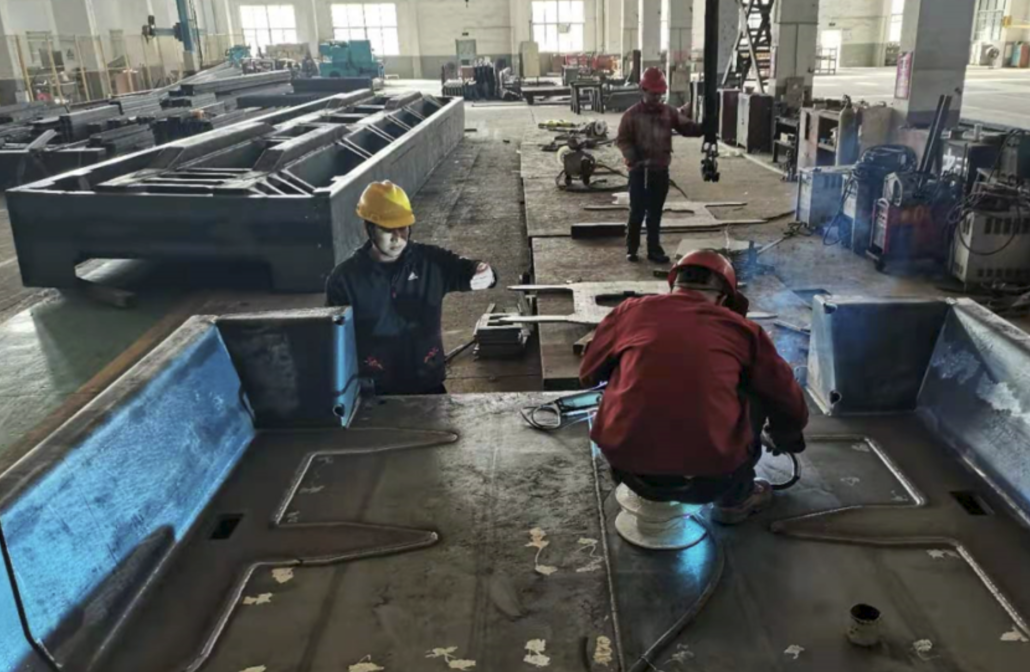
Welding fabrication of AGV steel chassis — full-penetration joints on 25 mm S355JR main beams, with welding sequence planned to control distortion across the 15 m length.
The order of operations on a heavy AGV chassis is not flexible. Moving a machining step before welding, or skipping a stress-relief pass, changes the finished geometry. The sequence Openex uses for this class of weldment runs as follows.
- Map the load path to material zones on the drawing. Main longitudinal beams, cross members and suspension mounting pads are assigned to 25 mm S355JR. Container contact rails, skid landing areas and sliding surfaces are assigned to 20 mm NM400. Machining datums are marked on the drawing before any plate is cut, so that post-weld machining has a reference that does not depend on a flame-cut edge.
- Cut and bevel. Fiber laser cutting handles the profile work, and the bevel geometry on 25 mm plate is set to support full-penetration welding. Bevel angle, root gap and land thickness are fixed in the WPS rather than left to the operator.
- Weld under fixture. The chassis is assembled in a fixture that holds the 15 m span. Welding processes available for this work include SMAW, GMAW/MIG, GTAW/TIG, SAW and robotic welding, and Openex runs AWS-certified structural welding for chassis and frame work. The welding sequence is planned so that heat is distributed across the frame instead of concentrated at one end, which is the main lever for controlling bow and camber over 15 m.
- Machine after welding. This is the step that separates a usable chassis from a welded frame. Suspension mounting faces, hinge ears, locating pads and bolt patterns are machined after the weld has cooled, not before. Openex uses CNC gantry machining centers, CNC vertical and horizontal machining centers, boring mills and large CNC equipment with travel up to 50 m x 8 m x 7 m. For comparable long weldments, the shop works to straightness tolerances in the range of 3.0 mm per 10,000 mm on an 8 m formed box section — the same discipline that keeps wheel loads even on a 15 m chassis.
- Surface preparation and coating. Blasting, pickling and degreasing precede primer and topcoat, powder coating, electroplating or hot-dip galvanizing. For AGV chassis, blasting followed by a paint system is the common path; the point is that the coating is applied after machining, so that machined faces are not buried under overspray.
- Inspect and release. Dimensional inspection covers length, angle, straightness, flatness and position of the mounting features. Openex operates a Zeiss large CMM with 7 m x 4 m x 3 m capacity and micron-level resolution, alongside NDT methods including RT, UT, MT, PT and VT, plus destructive testing for chemical composition and mechanical properties when the project calls for it.
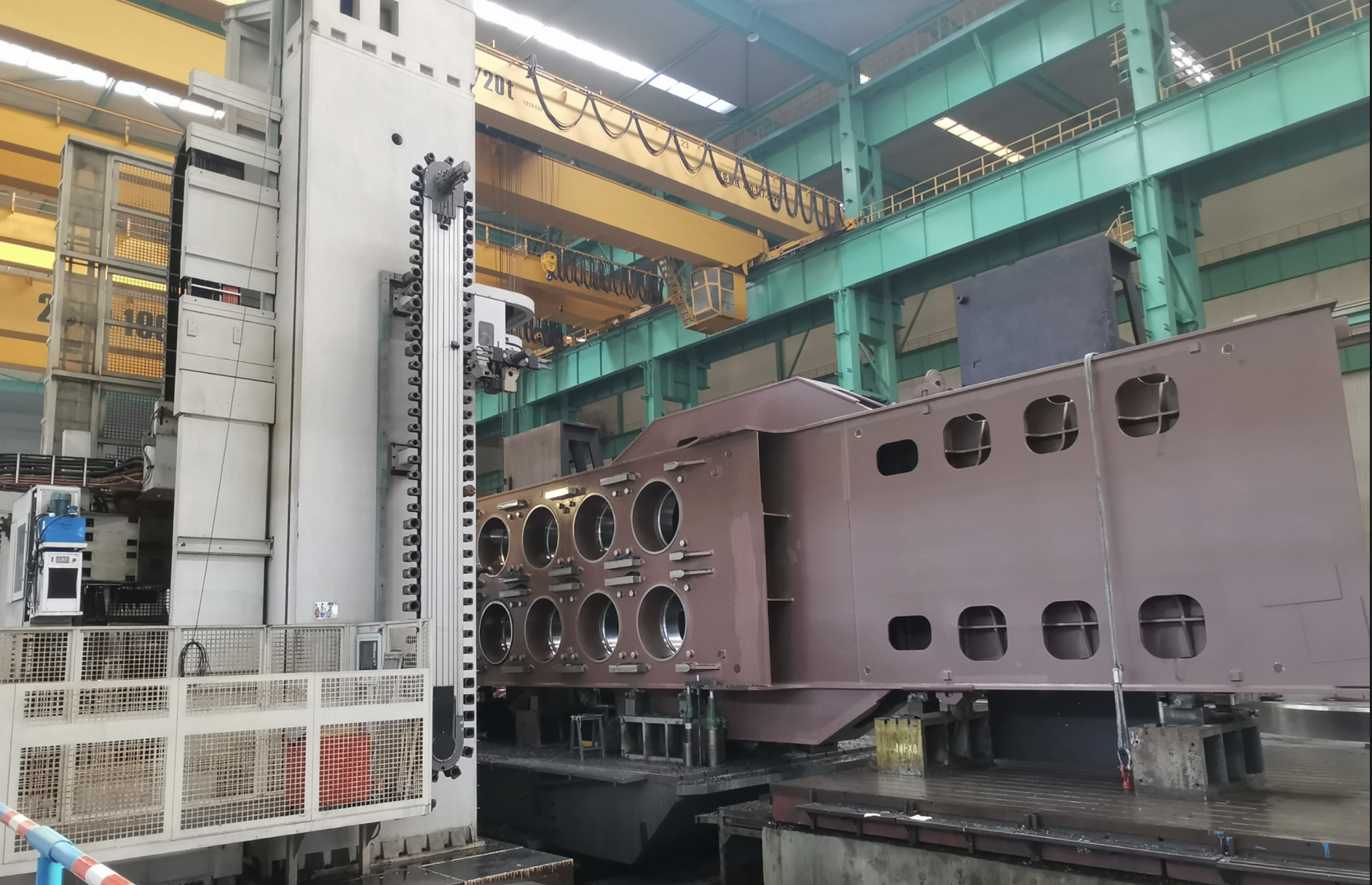
Large CNC milling and drilling center near Shanghai Port — post-weld machining restores mounting-face flatness and hole position after the 15 m frame has been welded.
Where These Parameters Have Been Proven in Service
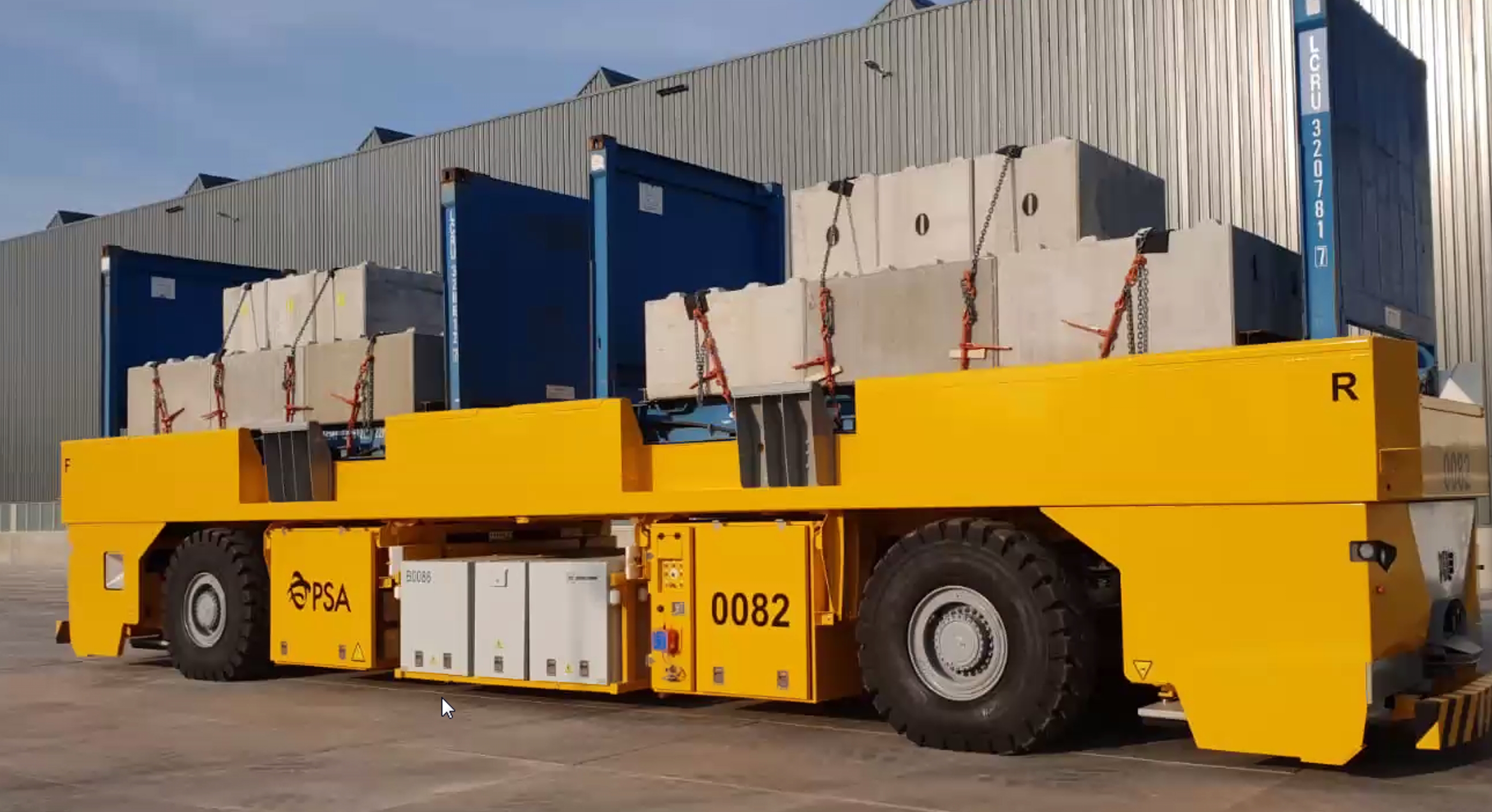
Container AGV in service at a Singapore container yard — 24/7 heavy-load operation on steel chassis fabricated by Openex.
Two AGV programs and one adjacent heavy-chassis program give a realistic picture of what the PSA-1 parameter set has to survive.
Singapore container yard. The container AGV application runs 24/7 under heavy and large loads, carrying ocean containers in a yard environment. The chassis have to tolerate repeated container placement, salt-air exposure and continuous duty cycles. The working condition is the reason the wear plate is specified at the container contact areas rather than only on the underside of the frame.
Dutch large-AGV manufacturer. Openex supplied 345 custom steel chassis to a large AGV manufacturer in the Netherlands, for vehicles designed to carry ocean-worthy containers, LNG tanks and other large objects. The design life on that program is over 30 years, and the delivered units have been in stable operation for more than four years. The requirement that drove the build was strict conformance to specification, with high precision and dimensional control across a large weldment.
Adjacent heavy-chassis reference: JFE-1 steel mill pallet chassis. A different but structurally related project — a steel chassis built for a Japanese steel mill to store and transfer steel coils — shows how the same fabrication logic behaves over a long service life. The JFE-1 unit weighs 10 tons, measures approximately 15 m x 2.5 m x 2.1 m, and carries a maximum load of 35 tons, with the delivered units in stable operation for 20 years. It is not an AGV, but it shares the load case that matters: a long welded steel frame carrying a concentrated heavy load, built to hold its geometry for decades.
S355JR vs NM400: Which Plate Carries Which Load
The two plate grades on PSA-1 are not competing materials. They are assigned to different load cases, and confusing the two is one of the most common specification errors on a heavy AGV chassis.
| Parameter | S355JR / A572 Grade 50 | NM400 |
|---|---|---|
| Plate thickness on PSA-1 | 25 mm | 20 mm |
| Function in the chassis | Primary structural frame — carries bending and shear | Wear and contact surface — carries sliding and impact abrasion |
| Typical locations | Longitudinal beams, cross members, suspension mounting pads | Container contact rails, skid landing zones, sliding surfaces |
| Key fabrication steps | Cutting, beveling, full-penetration welding, post-weld machining | Cutting, controlled-heat-input welding, machining of wear-zone features |
| Main geometry risk if not controlled | Longitudinal bow and uneven wheel loading | Dimensional shift at contact points after welding |
| Surface treatment compatibility | Blasting, primer/topcoat, powder coating, galvanizing | Blasting, primer/topcoat, powder coating |
| Openex process coverage | Laser cutting, bending, AWS-certified structural welding, large CNC machining, CMM inspection | Same cutting, welding and machining cells, with heat-input control around the wear zone |
| Why it is specified | Structural strength with weldability and machinability at 25 mm | Abrasion resistance where structural plate would wear through |
The table also explains why substituting one grade for the other does not work. Putting NM400 into the main beams would trade weldability and machinability for wear resistance the beams do not need. Putting S355JR into the container contact zones would save cost on the drawing and cost far more in service, because the contact geometry would wear and the locating points would move.
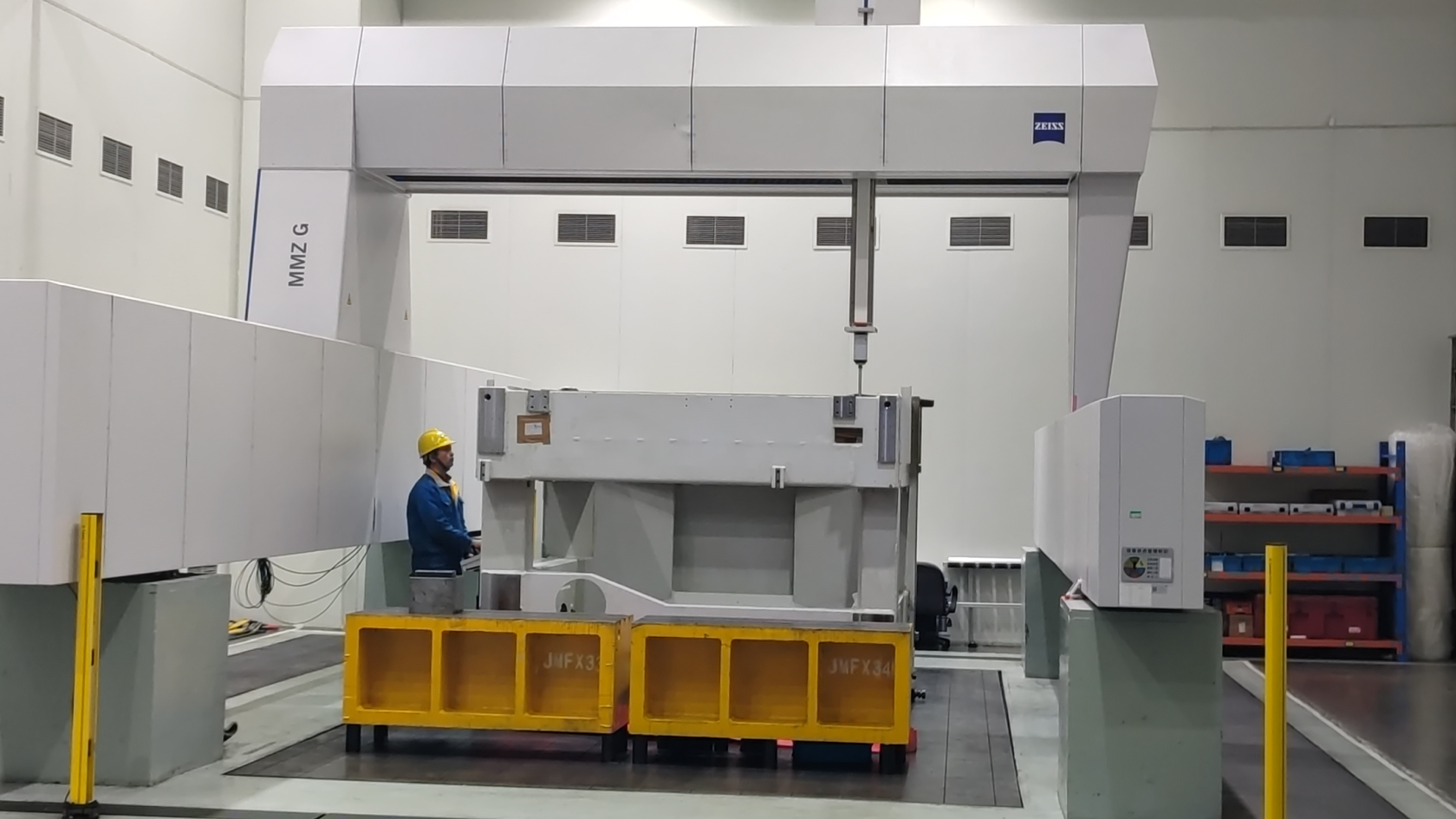
Zeiss large CMM with 7 m x 4 m x 3 m working capacity — final dimensional verification of straightness and mounting-face position before release.
Frequently Asked Questions
What welding procedures apply to a thick-plate AGV chassis?
A 25 mm chassis plate is outside the scope of AWS D9.1/D9.1M:2026, which covers non-structural sheet metal welding up to 3 gauge or 0.250 in (6.4 mm). Structural welding procedures therefore have to be written specifically for the chassis: a welding procedure specification (WPS), procedure qualification record (PQR) and welder qualification, with inspection by visual, dimensional and NDT methods including RT, UT, MT and PT. Openex works to AWS-certified structural welding on chassis and frame projects and can qualify procedures against a customer-supplied WPS where required.
Can a sheet metal fabrication manufacturer also produce large prefabricated AGV steel chassis?
It can, if the shop has the plate-handling and post-weld machining capability that a large chassis requires. Openex runs custom metal fabrication from two manufacturing premises near Xiamen Port and Shanghai Port, covering carbon steel, stainless steel and thick-plate work. The relevant capacity for AGV chassis includes overhead cranes above 250 tons, bending equipment above 18 m and 10,000 tons, CNC travel up to 50 m x 8 m x 7 m, AWS-certified structural welding, large CNC machining and a Zeiss CMM with 7 m x 4 m x 3 m capacity. Sheet metal work and heavy chassis work can sit in the same supplier only when both the forming and the post-weld machining cells are present.
What drives the cost of a 30-ton AGV steel chassis?
Four variables dominate. First, plate grade and thickness — 25 mm S355JR or A572 Grade 50 for structure and 20 mm NM400 for wear are different cost lines, and mixing them across the frame changes both material and welding cost. Second, total weld length and the share of full-penetration joints, which sets labour and inspection time. Third, the area and tolerance of post-weld machining, since machined mounting faces are what keep the chassis usable. Fourth, surface treatment — blasting plus a paint system, powder coating or galvanizing each carry different preparation and cycle time. A quotation that lists only tonnage will not show which of these is driving the number.
Can a prototype or first chassis be produced before series production?
Yes. Openex works from customer drawings and produces prototype and first-article chassis before series release, with dimensional inspection and NDT on the first unit. The welding side of the business runs to a monthly capacity of 5,000 tons with a 25-ton minimum order quantity and a 30–45 day lead time; the machining side runs to 3,000 tons per month with a 15-ton minimum and a 30–45 day lead time. A heavy chassis sits across both, so the prototype schedule is normally set by the machining and inspection steps rather than by cutting.
What is the lead time and export arrangement for AGV chassis?
Fabrication and machining each carry a 30–45 day lead time, and surface treatment adds a separate cycle depending on the coating system. Because a chassis passes through cutting, welding, machining and coating in sequence, the project schedule is built from those steps rather than from a single shop-floor date. Openex exports roughly 80% of its output, with main markets including the EU, USA, Australia, New Zealand, Japan, Singapore, South America and the Middle East, and ships from the Xiamen and Shanghai port areas. To discuss a specific AGV chassis project, send the drawing and load case to sales2@openex.com.cn or download the Openex fabrication brochure for the full process list.
Conclusion
A 30-ton AGV steel chassis is a material assignment problem before it is a welding problem. PSA-1 answers it with 25 mm S355JR or A572 Grade 50 on the load-bearing frame and 20 mm NM400 on the wear surfaces, sized around a 15 m x 2.7 m x 3 m envelope, 10.5-ton dead weight and 30-ton load capacity. The fabrication sequence then has to protect that assignment: beveled full-penetration welds, a fixture that holds the span, machining after welding rather than before, and dimensional inspection that confirms straightness and mounting-face position before the chassis leaves the shop.
Get those parameters aligned and the chassis behaves like a platform. Get them out of order and the same steel becomes a frame that has to be shimmed in the field.
Working on a Heavy AGV or Container Chassis?
Send the drawing, load case and plate specification to sales2@openex.com.cn or contact +86 150 6078 7506 (WhatsApp available). Openex can review the material split, welding procedure and post-weld machining requirement, and return a fabrication scope against your chassis dimensions.
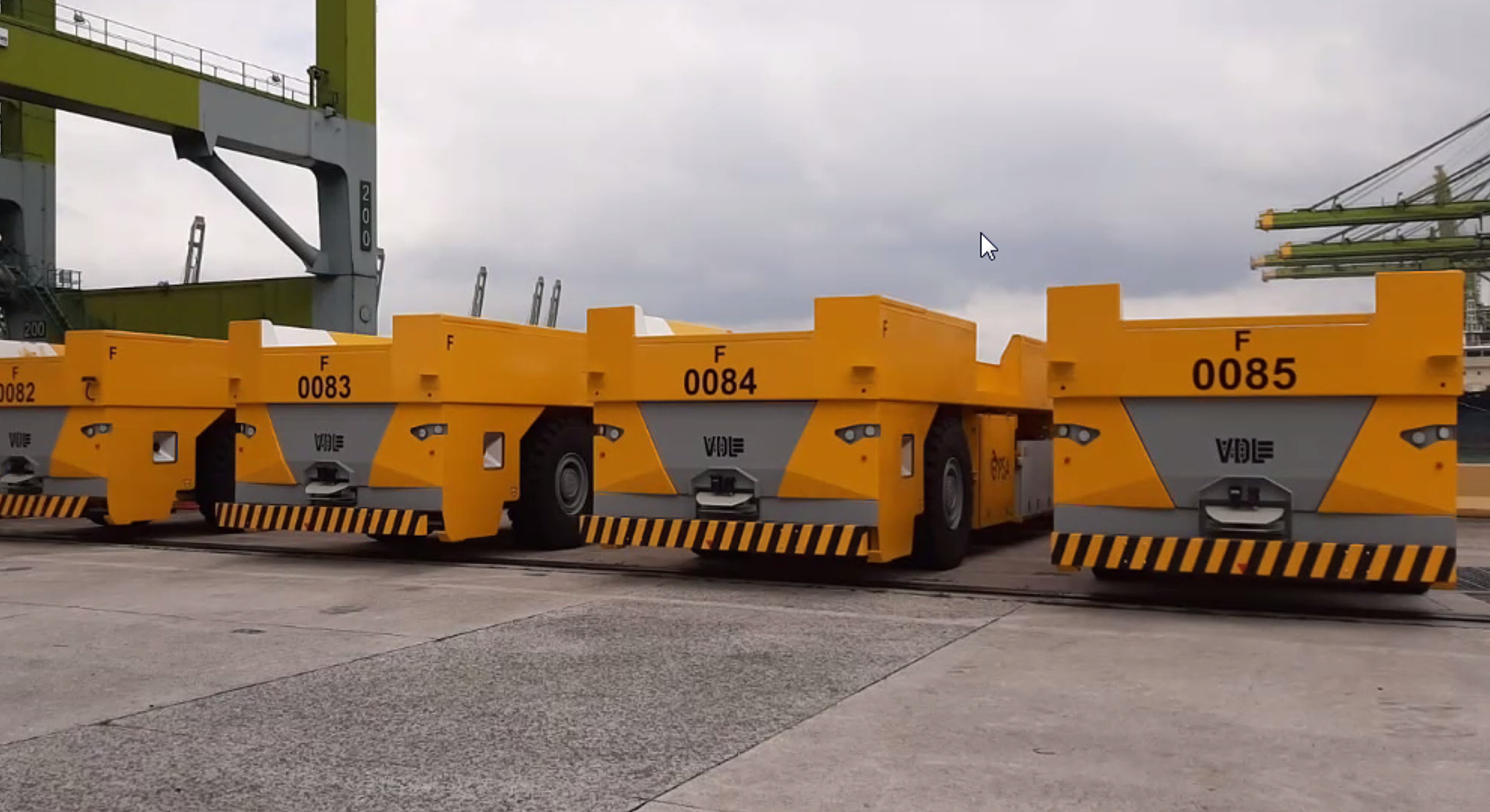
AGV steel chassis ready for shipment — fabricated, machined, coated and inspected before export from the Xiamen and Shanghai port areas.
Have Questions or Need More Details?
Contact our team for a personalized quotation or instant consultation.
Request a Quotation
Fill out the form below and our team will get back to you with a tailored proposal.
WhatsApp Direct Chat
Prefer to chat in real-time? Message us on WhatsApp for instant assistance & quick answers.
- Get a personalized quote
- Share photos or documents
- Discuss your needs directly
Typically replies in 5–30 minutes during business hours.