What Is Large Metal Fabrication? AGV Chassis, Vacuum Chambers, and Heavy Weldments Explained
Large metal fabrication is the custom manufacture of welded, machined and pressure-retaining metal assemblies that are too large, too heavy or too project-specific to be bought from a catalogue. The parts are measured in metres rather than millimetres, and the category sits behind automated guided vehicle (AGV) chassis, steel frames for battery energy storage, thermal vacuum chambers, heavy equipment skids, and process vessels such as feed surge drums and crystallization reactors.
If you are new to the category, the hard part is rarely the metal. It is the vocabulary. A buyer arrives with a drawing and a deadline, then discovers that "fabrication" can describe four or five different supply chains with different tooling, different inspection logic and different cost drivers. This article explains what the category actually covers, where the boundary lines run between a weldment, a casting and a machined component, and what a buyer should have ready before contacting a fabricator.
What Large Metal Fabrication Actually Covers
Large metal fabrication is defined by three things: physical scale, a load or pressure path that has to be engineered, and full drawing control from the buyer. Anything that is quoted from a drawing with defined material, weld, tolerance and inspection requirements is normally in scope.
In scope in most large fabrication programmes:
- Welded steel structures — chassis, frames, skids, bases, beams, columns, ladders and guardrails
- Pressure-retaining equipment — pressure vessels, pressure tanks, heat exchanger cores, feed surge drums, crystallization reactors and tube sheets
- Vacuum and containment hardware — thermal vacuum chambers, large box vacuum chambers and sealed shells
- Large machined components produced from plate, castings or finished weldments
- Prefabricated pipeline spools and process modules
- Surface finishing applied to the above — blasting, painting, powder coating, galvanizing and pickling
Usually out of scope: catalogue fasteners, standard bearings, off-the-shelf gearboxes, electrical panels and instrumentation. Buyers sometimes assume a fabricator supplies these because the drawing shows them; in practice the fabricator supplies the metal structure and the interfaces that other vendors bolt onto.
The Problem: "Fabrication" Is a Process Word, Not a Product Word
The most common mistake first-time buyers make is comparing quotations as if they describe the same product. They usually do not. One supplier quotes a raw weldment. Another quotes a weldment plus post-weld machining on the mounting faces. A third quotes the same weldment with non-destructive testing, stress relief, surface finishing, preassembly and a final inspection report. The three prices can differ substantially without any supplier being unfair — the scope is simply different.
This scope gap shows up later as three predictable problems. First, tolerance disputes: a frame welded from plate will move during welding, so any flatness or position tolerance on a mounting pad has to be achieved by machining after welding, and that operation has to be in the quote. Second, documentation gaps: pressure and vacuum equipment may need radiography, ultrasonic testing, dye penetrant testing or a helium leak test, and those tests are line items, not free extras. Third, interface failures: a chassis or skid is rarely a standalone item — it carries an engine, a battery module, a compressor or a vacuum pump, and the interface dimensions matter more than the outline dimensions.
A workable definition for procurement is therefore: large metal fabrication is a drawing-driven engineering service in which the fabricator owns the process route from raw plate or casting to a verified, finished assembly. Once the buyer accepts that framing, the questions to ask become obvious — and so does the information the fabricator needs.
Industry Background: Why the Category Has Grown
Large metal fabrication used to be a regional business, because heavy weldments are expensive to ship and difficult to inspect remotely. That has changed for a practical reason: the equipment that needs these structures has become more specialised and more distributed.
Automated guided vehicles and autonomous yard tractors need long, stiff, impact-resistant chassis. Battery energy storage systems need steel shelves, boxes and liquid-cooling cabinets that hold modules safely and stay dimensionally stable in a container. Vacuum-based coating, semiconductor and aerospace processes need chambers with controlled leak rates. Oil, gas, petrochemical and power projects need pressure vessels, feed surge drums, crystallization reactors and heat exchanger cores built to specification. Each of these is a low-volume, drawing-specific item, which is exactly the profile that suits a custom fabricator rather than a mass-production plant.
This is the context in which Openex fabrication operates. Xiamen Openex Mechanical Technology Ltd was founded in 2009 and runs two manufacturing premises, one near Xiamen Port and one near Shanghai Port, with 30,000 ㎡ of factory space, 200 employees, 35 engineers and an annual output of 20,000 tons. Around 80% of output is exported to the EU, USA, Australia, New Zealand, Japan, Singapore, South America and the Middle East — which is why export documentation, packing and remote inspection matter as much as the welding itself.
Weldment, Casting, Machined Component: The Three Families
Most confusion disappears once a buyer can place a part into one of three families. The families describe how the shape is created, not what the part does.
Weldments: shapes assembled from plate, tube and rolled sections
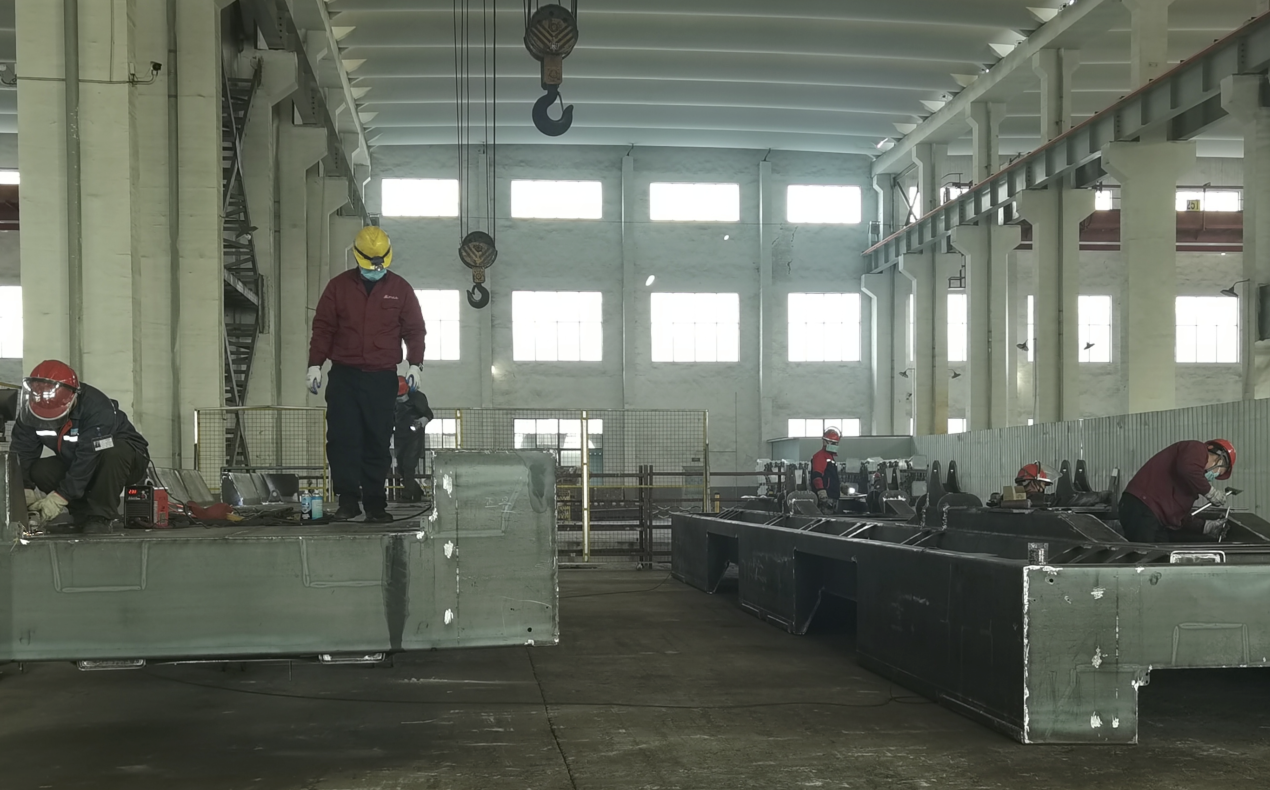
A weldment starts as cut plate, tube, beam, angle or channel, which is then formed, fitted and welded into a single structure. It is the natural choice for large, stiff, one-off or low-volume geometry: AGV chassis, equipment skids, machine bases, press frames, crossbeams, conveyor frames and structural supports. Weldments need no pattern or die, so design changes between units are practical. Their weakness is distortion — welding introduces heat and movement, so critical faces are usually machined after welding and, where the drawing requires it, the part is stress-relieved before final machining.
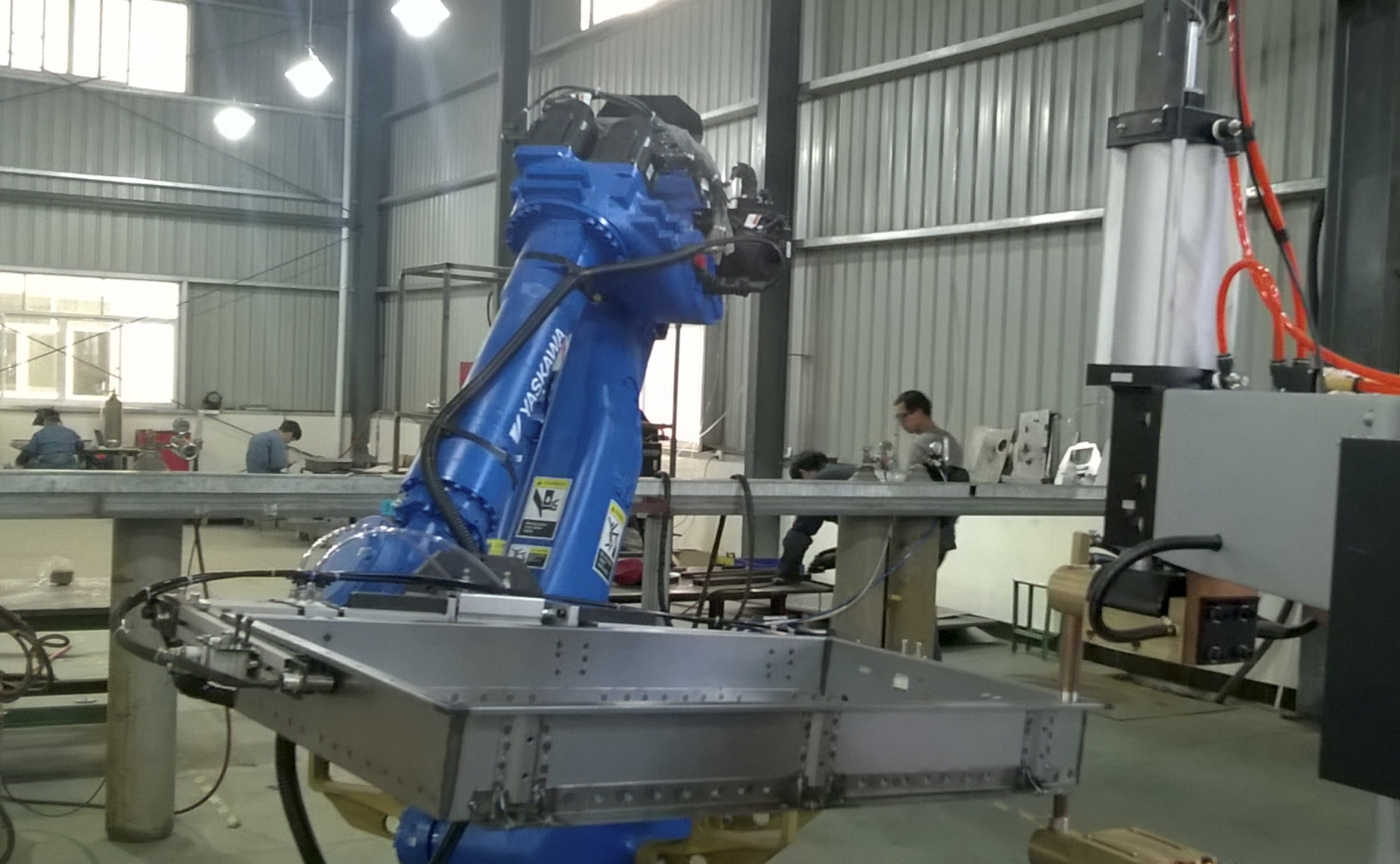
Material choice inside the family is wide. Openex fabrication works carbon steels, stainless steels, duplex and super duplex stainless, clad and composite plate, and low-alloy steels, with welding processes covering SMAW, GMAW/MIG, GTAW/TIG, SAW, automatic tube-to-tubesheet welding, deep penetration welding and robotic welding. Post-weld operations available include pre- and post-weld heat treatment, distortion control planning, pickling and passivation for stainless, and grit blasting for carbon steel.
Castings: shapes created from a mould
A casting is produced by filling a mould with molten metal, so the geometry is created before any metal is cut. Castings suit complex internal features, repeated production and shapes that would be wasteful to machine or weld from solid. The trade-off is lead time at the front end: a pattern or die is normally required before the first part exists, and design changes are more expensive than in a weldment.
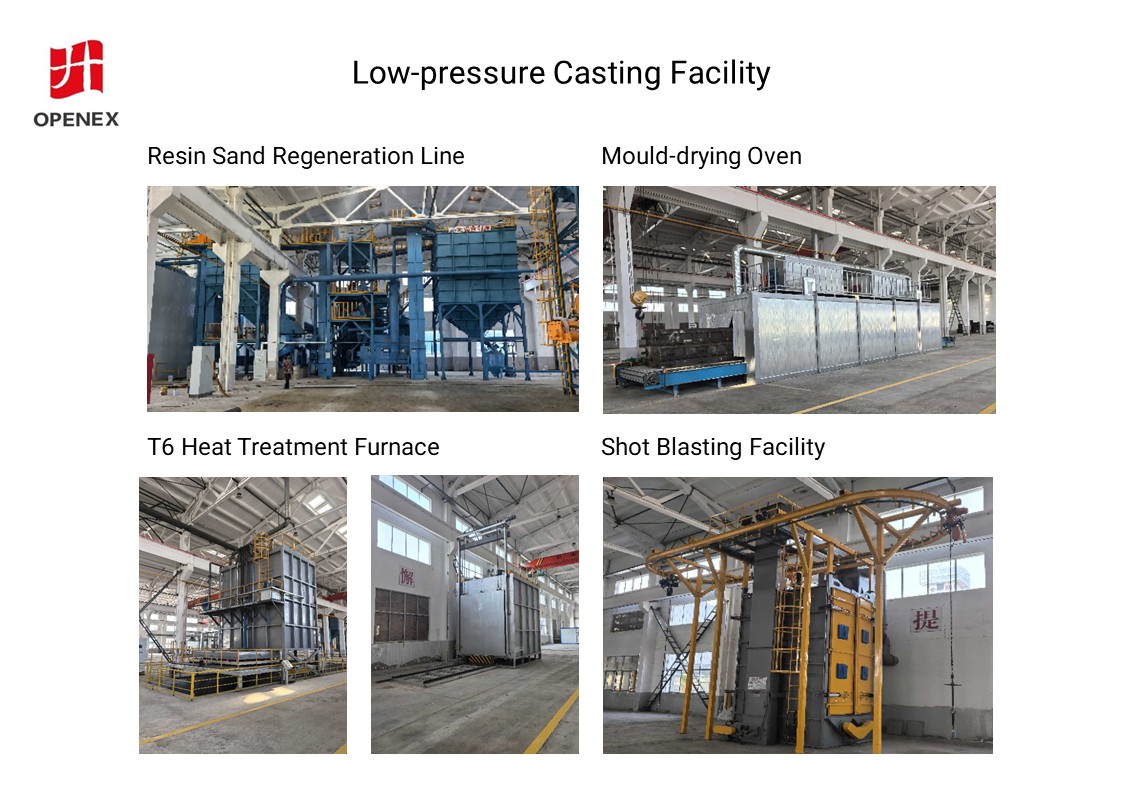
Openex fabrication supplies aluminium castings produced by low pressure die casting, low pressure sand casting and precision investment casting in AlSi7Mg cast aluminium alloy, with in-house T6 heat treatment, CNC machining, vacuum impregnation and surface coating. Design validation uses MAGMA casting simulation at project kickoff to check structural integrity and porosity risk before a mould is cut, and castings are released against 100% non-destructive testing. Castings are also frequently combined with weldments — a cast hinge welded to a steel beam is a real example from a modular housing project, where cast hinges were welded onto steel I-beams and secured with high-strength stainless pins.
Machined components: accuracy applied to an existing blank
A machined component starts from something that already exists — plate, bar, a casting or a finished weldment — and gets its accuracy from cutting tools. Machining is where flatness, bore position, coaxiality, perpendicularity and surface roughness are decided. In large fabrication projects, machining is usually the operation that turns a welded structure into a usable machine interface.
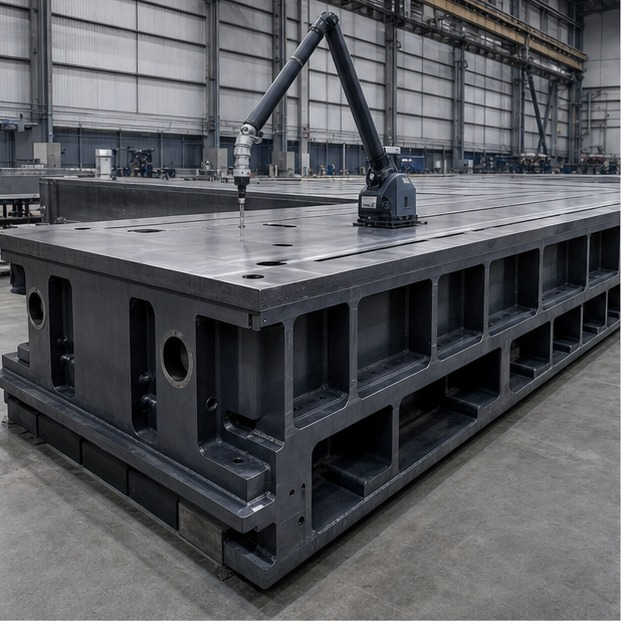
The scale matters here. Openex fabrication runs CNC vertical and horizontal lathes, gantry machining centres, boring mills, deep hole drilling machines, laser cutting machines and turning, milling, drilling, boring, reaming, tapping, grinding and polishing operations, with heat treatment and coating integrated into the route. Maximum CNC machine tool travel is up to 50 m × 8 m × 7 m, and inspection is supported by a Zeiss large CMM with 7 m × 4 m × 3 m capacity. Typical outputs include tube sheets, large machined platens, machine bases, turbine rings and precision frames.
Where prefabrication of pipelines fits
Pipeline prefabrication sits between fabrication and site construction. Instead of welding pipe spools on site, the spools, supports and skid-mounted process modules are fabricated and tested in a workshop, then shipped as modules for final connection. In the Openex range this appears as prefabrication of pipelines and as assembled process skids. The practical benefit is that welding, testing and inspection happen under workshop conditions rather than in a field environment with weather, access and labour constraints — and the buyer receives a dimensional record before shipment instead of after.
What Large Metal Fabrication Looks Like Across Product Types
AGV steel chassis
An AGV steel chassis is a long, heavy weldment that must stay straight while carrying concentrated loads. The PSA-1 chassis supplied for container AGVs is 15 m × 2.7 m × 3 m, weighs 10.5 tons and is rated for a 30-ton loading capacity, built from 25 mm S355JR (or A572 Grade 50) high-strength steel plate with 20 mm NM400 abrasion-resistant plate in the wear areas. It illustrates why chassis work is a fabrication discipline rather than a machining one: the geometry is defined by plate size, fit-up and weld sequence, and the finished part is inspected with penetrant testing on the weldments before painting. One Dutch AGV builder has taken 345 units, in stable operation for more than four years.
Steel frames and enclosures for energy storage
Battery energy storage systems need steel shelves, boxes and cabinets that hold modules in a fixed position and survive transport. The XHC-009 storage frame measures 1.1 m × 1.1 m × 2.2 m, weighs 1000 kg per unit and is powder coated for corrosion protection; steel boxes loaded with cells are assembled into the shelf before the shelf goes into a container. A related programme produced 3,000 units where the acceptance criteria were simply no rust, no leakage and no deformation — which is what dimensional stability looks like as a customer requirement.
Vacuum chambers
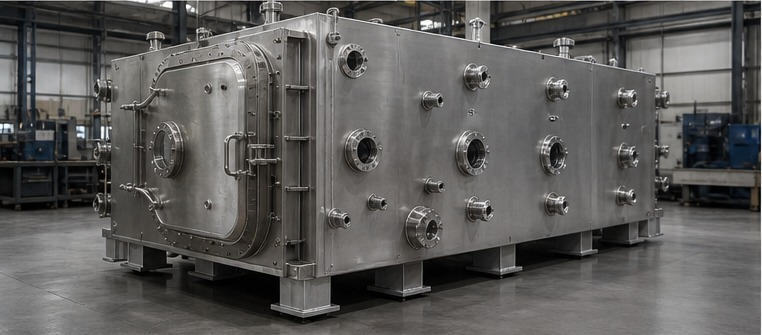
Vacuum work is where large fabrication meets containment. The Custom-L-9 large box vacuum chamber has an internal size of 2,000 mm × 1,500 mm × 1,500 mm, a nominal wall of 12 mm with external stiffeners, a design vacuum of ≤1 × 10⁻⁵ mbar and a helium leak rate of ≤1 × 10⁻⁸ mbar·L/s after final testing, in stainless steel 304L with aluminium 6061-T6 used for door or access components. Port layout is customised to the drawing. The engineering logic is different from a structural weldment: weld quality and leak rate govern acceptance, and wall and stiffener design has to be confirmed by vacuum engineering before fabrication starts.
Skids, machine bases and structural frames
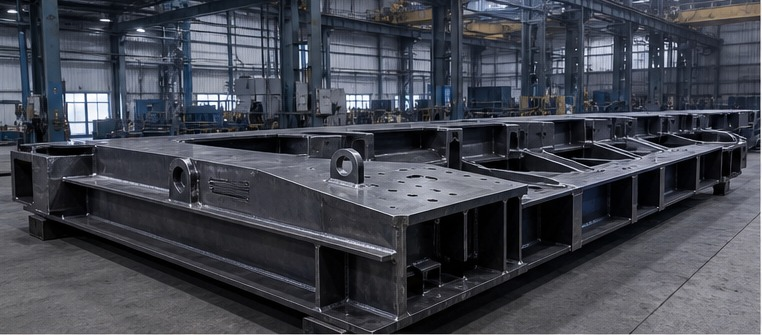
Skids and bases carry equipment, so flatness and load path dominate. The Custom-L-6 heavy equipment skid is built at a typical reference size of 8,000 mm × 3,000 mm × 1,200 mm with a design equipment load of 30–60 t, primary members of H300–H500, an estimated skid mass of 12–20 t and mounting-pad flatness of ≤0.20 mm per 1,000 mm, in ASTM A36, ASTM A572 Grade 50 or SS304 for corrosive service. At the smaller end, the B-300 welded machine base covers 24 × 24 in to 72 × 96 in, with 1 in, 1.5 in or 2 in top plate, 3 × 3 × 1/4 in tube (4 × 4 × 3/8 in above 20 sq ft), welded, stress-relieved and shot-blasted, with ground-top flatness of ±0.001 in cumulative.
Process vessels: feed surge drums, crystallization reactors and tube sheets
Pressure-retaining equipment is the most documentation-heavy part of the category. Openex fabrication supplies pressure vessels and pressure tanks, heat exchanger cores, feed surge drums, crystallization reactors, large carbon steel condensers and tube sheets for oil and gas, petrochemical, refining, power plant and offshore applications. A tube sheet programme for an Indonesian power plant heat exchanger ran to 45 tons and was released through remote pre-shipment inspection; a pressure vessel programme for oil, gas and power plant customers has been in stable operation for ten years. These items are accepted on weld procedure qualification, non-destructive testing (RT, UT, MT, PT, VT and LT), hydrostatic or pneumatic testing and dimensional records rather than on appearance alone.
Comparison Table: Weldment vs Casting vs Machined Component
| Decision point | Weldment | Casting | Machined component |
|---|---|---|---|
| How the shape is created | Cut, formed and welded plate, tube and sections | Mould filled with molten metal; model and mould tooling | Material removed from plate, bar, casting or finished weldment by cutting tools |
| Tooling before first part | Drawing, WPS/PQR and fixtures; no pattern required | Pattern or die required; MAGMA simulation used at kickoff for validation | Fixtures, jigs and CAM programming |
| Materials used at Openex fabrication | Carbon, stainless, duplex/super duplex, clad/composite plate, low-alloy steels; S355JR, A572 Gr 50, NM400, SS304/304L | AlSi7Mg cast aluminium alloy via low pressure die casting, low pressure sand casting, precision investment casting | Carbon steels, alloy steels, stainless steels and alloys |
| Where accuracy comes from | Fit-up and weld sequence, then machining after welding and stress relief where specified | Mould accuracy plus post-cast machining, T6 heat treatment and impregnation | Machine tool capability; tolerances include flatness, straightness, concentricity, position and Ra |
| Typical inspection | VT, dimensional check, RT/UT/MT/PT, TOFD or phased array, hardness, hydrostatic or pneumatic test | 100% NDT testing, leakage test, dimensional measurement | 100% inspection; CMM measurement up to 7 m × 4 m × 3 m |
| Best fit | Large, stiff, low-volume structures: chassis, skids, frames, bases, supports | Complex internal features and repeated parts where mould tooling is justified | Interfaces and features where tolerance or surface finish decides function |
| Where it stops making sense | Very high unit volumes where per-part labour dominates, or geometry that cannot be welded and accessed | Single large parts with no repeat volume, or very short lead-time changes | Removing large volumes of material that could have been formed or cast near-net |
Step by Step: How a Large Fabrication Order Actually Runs
- Drawing and specification review. The fabricator confirms material grades, welding standard, tolerances, inspection class, surface finish, marking and packing. Ambiguities are resolved here, because changing scope after cutting has started is expensive for both sides.
- Process route and WPS/PQR. Welding procedure specifications and qualification records are confirmed, together with weld joint design, bevel angles, root gap and whether post-weld heat treatment is required.
- Material procurement and traceability. Plate and section are sourced with material test certificates so the finished part can be traced back to the heat number.
- Cutting and forming. Laser cutting, punching/stamping, roll forming, bending and rolling produce the components. Openex fabrication runs a press brake with maximum length over 18 m and tonnage over 10,000 tons, which is what allows long members to be formed in one piece rather than spliced.
- Fit-up and welding. Welding is carried out with SMAW, GMAW/MIG, GTAW/TIG, SAW, automatic tube-to-tubesheet, deep penetration or robotic welding as the drawing requires. A 6-axis welding robot holds ±0.05 mm repeat positioning accuracy, and a SAF PL130 plasma welding machine handles 1–10 mm wall over a 12.5 m tube length.
- Post-weld treatment. Stress relief, distortion control and post-weld cleaning (pickling and passivation for stainless, grit blasting for carbon steel) are applied where specified.
- Machining after welding. Mounting pads, bores, spigots and mating faces are machined on large CNC equipment so that flatness and position are achieved after the weld has moved the structure — not before.
- Inspection and testing. Visual and dimensional checks, NDT (RT, UT, MT, PT, VT, LT), TOFD/phased array, hardness, hydrostatic or pneumatic testing, corrosion testing and residual stress analysis are applied according to the acceptance class.
- Surface finishing and assembly. Blasting, phosphating, passivation, spray painting, powder coating, electroplating and hot-dip galvanizing are available in-house, followed by preassembly and functional testing where the order calls for it.
- Packing, documentation and shipment. Parts are packed for the transport mode, with inspection reports and material certificates issued against the delivery.
For planning, the published capability anchors at Openex fabrication are: welding at a monthly capacity of 5,000 tons with a 30–45 day lead time and a 25-ton minimum order; machining at 3,000 tons per month with a 30–45 day lead time and a 15-ton minimum; and surface treatment at a 45-day lead time with a 15-ton minimum. These are capability figures rather than a quotation — a specific drawing can move in either direction.
Use Cases: Where Large Fabrication Earns Its Place
- Port and yard automation. Container AGV chassis at 345 units for a Dutch builder, and a steel chassis programme for a Japanese steel mill at 30 units that has been in stable operation for 20 years.
- Energy storage. Steel shelves and boxes for battery energy storage, plus liquid-cooling cabinets, with programmes running to 3,000 units.
- Renewables. A wind tree structure at 300 tons where components were preassembled to prove manufacturing precision, then disassembled and packed for shipment; solar panel support frames at 1,000 units.
- Flywheel energy storage. 400 units of steel shells fabricated, rough turned, welded, finish turned and released with final inspection reports.
- Automotive and production lines. Chain conveyor frames for a Japanese car maker, supplied including assembly and testing, and 120 chain conveyors for a lithium battery production line.
- Heavy machinery. 45 units of steel bases for large machinery, using welding followed by large machining to achieve precision that could not be held on a welded surface alone.
- Oil, gas and power. Pressure vessels, condensers, heat exchangers, tube sheets and feed surge drums, plus prefabricated pipeline spools and process skids.
What the Certificates Actually Cover
Certificates are only useful to a buyer if the scope is read, not just the logo. Openex fabrication holds ISO 9001 certificate 11426Q01049R001, issued by Beijing East Allreach Certification Center Co., Ltd. against GB/T 19001-2016 / ISO 9001:2015, issued 2026-04-16 and valid to 2029-04-15. The registered scope is manufacture of machined parts, metal structures and sheet metal components, except where a licence is required. ISO 14001 (certificate 11426E00739R001) and ISO 45001 (certificate 11426S00656R001) are held on the same dates and cover the same manufacturing scope.
The practical reading is that the quality management system covers the processes described above — cutting, forming, welding, machining and finishing of metal structures and components. It is not a product approval for a specific vessel design, and it does not replace the design review, material certificates, weld procedure qualification and inspection records that a pressure or vacuum item requires. Buyers should ask for the certificate scope and the inspection dossier, and treat the two as separate pieces of evidence.
What to Prepare Before You Approach a Fabricator
- A dimensioned drawing in a neutral format. 2D drawings with tolerances, generally together with 3D models, plus the revision level that will be used for manufacture.
- Material and standard. Specify the grade rather than a generic description — S355JR, A572 Grade 50, NM400, SS304L and AlSi7Mg mean different process routes.
- Function of the part. State what the part does and which faces matter. A fabricator cannot infer that a mounting pad must be flat within 0.20 mm per 1,000 mm unless the drawing or the brief says so.
- Inspection and acceptance class. Which NDT methods, whether radiography, ultrasonic, penetrant or leak testing is required, and what the acceptance criteria are.
- Surface finish and colour. Painting system, powder coating, galvanizing or passivation, with the relevant standard and dry film requirements.
- Quantity and repeat forecast. One unit, a pilot batch and an annual programme follow different process routes; the minimum order quantities quoted above apply at capability level.
- Delivery and packing requirements. Transport mode, lifting points, sea-worthiness, container loading plan and whether preassembly is required before shipment.
- Documentation list. Material certificates, weld procedure qualification records, inspection reports, dimensional records and any third-party inspection arrangement.
Frequently Asked Questions
What does ISO 9001 certification actually cover for a metal fabrication manufacturer?
ISO 9001 certification covers a defined scope of manufacturing activity, not every product a company sells. At Openex fabrication, certificate 11426Q01049R001 is issued against GB/T 19001-2016 / ISO 9001:2015 by Beijing East Allreach Certification Center Co., Ltd., with a validity period from 2026-04-16 to 2029-04-15 and a scope covering the manufacture of machined parts, metal structures and sheet metal components, except where a licence is required. Environmental and occupational safety systems are certified separately under ISO 14001 and ISO 45001 on the same dates. A buyer should read the scope statement, then separately request the material certificates, weld procedure qualification and inspection records that apply to the specific part.
Can one fabricator handle an AGV chassis, a vacuum chamber and a pressure vessel at the same time?
It depends on lifting capacity, machine travel and welding qualification rather than on product names. Openex fabrication operates two premises near Xiamen Port and Shanghai Port with overhead crane tonnage over 250 tons, a press brake with maximum length over 18 m and tonnage over 10,000 tons, and CNC machine tool travel up to 50 m × 8 m × 7 m. The process range covers laser cutting, bending, punching/stamping, welding, machining, assembly, roll forming, casting, forging, galvanizing and powder coating, with monthly capacity of 5,000 tons for welding and 3,000 tons for machining. That combination is what allows a 15 m AGV chassis, a 2,000 mm box vacuum chamber and a tube sheet programme to run inside the same supply chain.
What drives the cost of a large metal fabrication order?
Cost is driven by the process route, not by weight alone. The main variables are material grade and plate thickness (25 mm S355JR and 20 mm NM400 behave very differently from mild steel), the amount of machining after welding, whether stress relief or post-weld heat treatment is required, the inspection class (visual and dimensional only, or full RT/UT/MT/PT with TOFD or phased array), the surface system (blasting only, or full painting, powder coating or hot-dip galvanizing), and the order quantity against the minimum order. At Openex fabrication the capability-level minimums are 25 tons for welding, 15 tons for machining and 15 tons for surface treatment, with lead times of 30–45 days for welding and machining and 45 days for surface treatment. Quotations should be compared line by line against this route, because a cheaper quotation is often a shorter route.
Can a large fabrication be validated before shipment instead of at the destination?
Yes, and preassembly is the strongest form of validation for large weldments. In a wind tree project of 300 tons, the steel components were preassembled to confirm manufacturing precision, then disassembled and packed for shipment. Chain conveyors for a Japanese car maker were supplied including assembly and testing. Flywheel energy storage shells at 400 units were released against final inspection reports before packing. Remote inspection is also practical: a 45-ton tube sheet programme for an Indonesian power plant was released through remote pre-shipment inspection, and a Zeiss large CMM with 7 m × 4 m × 3 m capacity supports dimensional verification for parts that are too large to check by hand.
What lead time should a buyer plan for a large fabricated assembly?
Plan from the process route rather than from a single number. Openex fabrication publishes 30–45 days for welding and 30–45 days for machining, with 45 days for surface treatment, measured from the point at which drawings, material and inspection requirements are confirmed. Front-end activities sit outside those figures: weld procedure qualification if a new material or joint is involved, casting pattern or die lead time where a casting is part of the assembly, and third-party inspection scheduling. For a first order, the realistic planning sequence is drawing freeze, process route confirmation, material lead time, fabrication, post-weld treatment, machining, inspection and finishing, then packing. Share the target delivery date with your drawing package — including the required inspection standard — so the route can be quoted against it rather than adjusted afterwards.
Conclusion: Start With the Drawing, Not With the Price
Large metal fabrication covers a wider range than most first-time buyers expect — from a 15 m AGV chassis and a 1000 kg energy storage frame to a 2,000 mm vacuum chamber, an 8 m equipment skid, a feed surge drum or a crystallization reactor. The common thread is not the product name. It is that each item is built from a drawing, verified against an inspection class, and delivered with records that let the buyer prove what was made.
Once a buyer can separate weldments from castings from machined components, and can see where pipeline prefabrication and surface finishing sit in the route, the quotation conversation becomes technical rather than commercial. That is the point at which cost, lead time and acceptance criteria can be compared fairly between suppliers.
Next step: send the drawing, not a description
Openex fabrication reviews enquiries against the drawing package — material grade, thickness, tolerances, inspection class and finishing. If the part is a weldment, a casting or a machined component, say which one you believe it is; if you are unsure, the process route can be proposed from the drawing.
Contact: Luna · sales2@openex.com.cn · Tel / WhatsApp: +86 150 6078 7506 · Unit 4801, No 99 Yilan Rd., Xiamen, FJ, China · www.cncmetalworking.com
Capability brochure (PDF): download the Openex fabrication catalogue.
Have Questions or Need More Details?
Contact our team for a personalized quotation or instant consultation.
Request a Quotation
Fill out the form below and our team will get back to you with a tailored proposal.
WhatsApp Direct Chat
Prefer to chat in real-time? Message us on WhatsApp for instant assistance & quick answers.
- Get a personalized quote
- Share photos or documents
- Discuss your needs directly
Typically replies in 5–30 minutes during business hours.