ISO 9001 Certified Metal Fabrication: What Buyers Must Verify
ISO 9001 Certified Metal Fabrication: What Buyers Must Verify
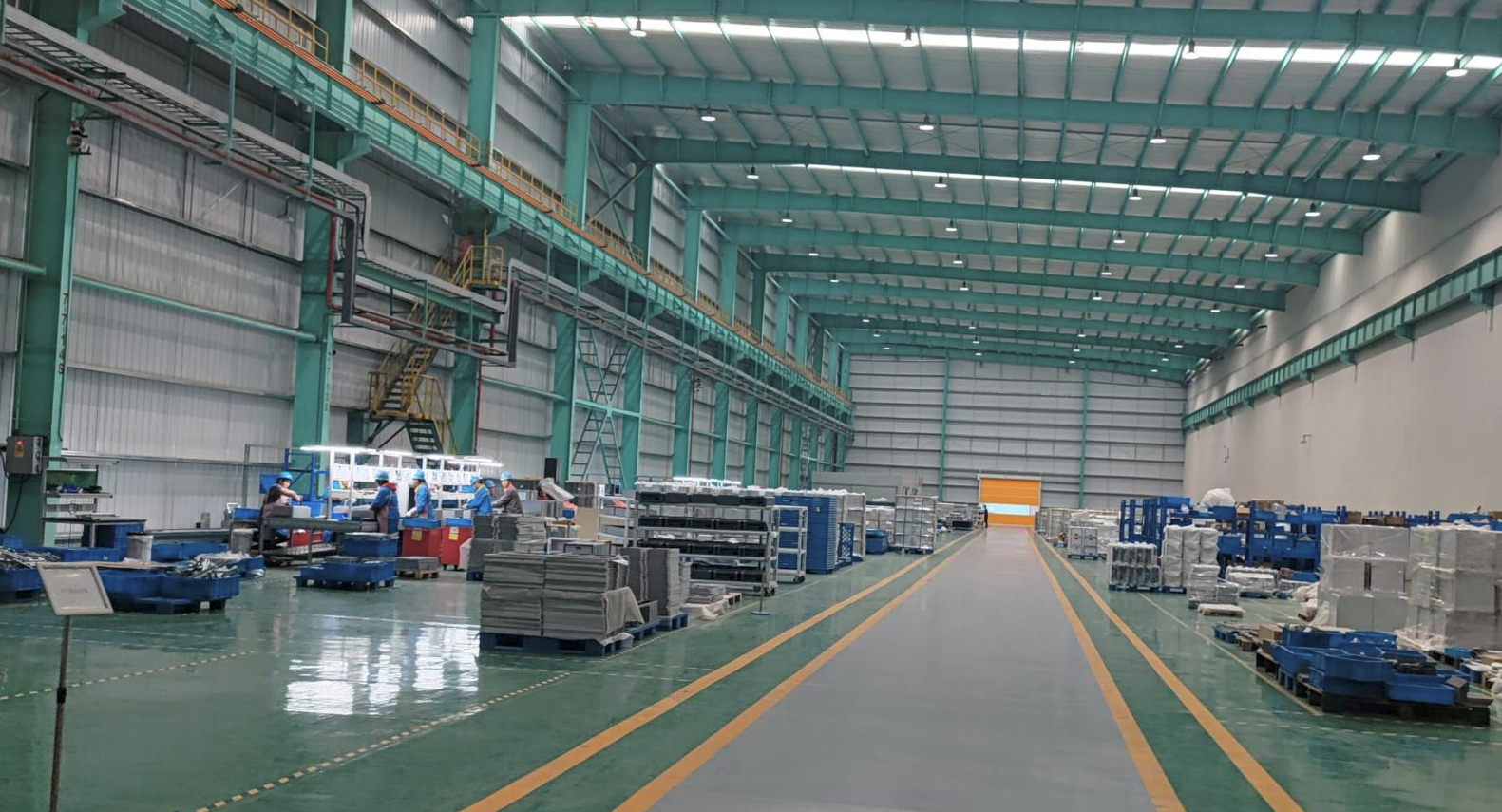
A certification is a scope document, not a capability statement. ISO 9001 confirms that a fabricator's quality management system has been audited against GB/T 19001-2016 / ISO 9001:2015. It does not confirm which welding processes are qualified, which material groups are approved, what flatness can be held on a large machined weldment, or which production steps are carried out in house. In custom metal fabrication, those four questions decide whether a supplier can actually deliver to your drawing, and all four can be verified before a purchase order is signed.
This guide is written for engineers, procurement managers and OEM project owners at the research and evaluation stage of sourcing steel fabrication, heavy weldments, machined structural components and pressure equipment. It sets out what the certifications held by Xiamen Openex Mechanical Technology Ltd (Openex) state word for word, where their scope ends, how to match them against a work package, and which dimensional and documentation limits should be confirmed in writing.
The Problem: A Certificate Is a Scope, Not a Capability
Three assumptions cause most of the rework, delay and cost overrun in custom metal fabrication contracts. Each one can be tested before an order is placed.
Assumption 1: certified means certified for our material. A welding certificate is written around a welding process and a material group. Openex holds ISO 3834-2 certification issued by SGS under certificate number 23/999-3834, valid until 2026-10-04, with a scope limited to fusion welding of metallic material, welding process 135 and 135-Auto, and material groups 1.1 and 1.2. Process 135 is the ISO 4063 designation for gas-shielded solid-wire welding, commonly called MIG/MAG. Material groups 1.1 and 1.2 correspond in practice to the common carbon and low-alloy structural steel families. A weldment in stainless steel 316L, duplex or aluminium therefore sits outside that certificate scope and needs its own welding documentation.
Assumption 2: manufactured in house means every step is in house. A certificate covers the scope of the certificate holder, not the scope of a partner's process. Openex performs laser cutting, bending, machining, welding, drilling, punching and stamping, assembling and packaging in its own two premises; casting, forging, hot-dip galvanizing and powder coating are supplied through long-term partners. That routing works well for most fabricated and machined work packages, but a project that needs only castings, only forgings or only an anti-rust finish is not the right fit for this supply route, and buyers should know it before the RFQ round rather than after.
Assumption 3: the drawing pack is complete. Fabricators price from the drawing pack. When the pack contains only a 3D model, the tolerance class, welding requirements, surface roughness and chamfer details, plate rolling direction, plate bend radius, material grade, heat treatment or stress relief method, and finish specification are all missing. Two suppliers then quote the same model against different assumptions, and the comparison is meaningless.
The constraint test: a certificate tells you that a management system is audited. The scope line, the material group, the process list, the machine envelope and the inspection plan tell you whether your part is deliverable.
Industry Background: Why Scope and Envelope Now Decide the Shortlist
In heavy industrial sectors such as energy storage systems, power plants, machinery, construction, mining, oil and gas, and nuclear, procurement teams commonly write certification, material traceability and third-party inspection into the RFQ itself rather than leaving them to the contract stage. Because fabrication work crosses borders and subcontracting layers, buyers increasingly use certification scope and machine envelope data as an early filter, since those two items determine feasibility before price is even discussed.
That shift has practical consequences for supplier evaluation. A fabricator able to cut, form, weld, machine, assemble, coat and inspect a large weldment under one quality system removes several interfaces from a project. A supplier that only welds, or only machines, adds handovers where tolerance stacks and documentation responsibility tend to get lost.
Openex operates from two manufacturing premises, one near Xiamen Port in Fujian and one near Shanghai Port in Jiangsu, with 30,000 m² of manufacturing space, 200 employees and 35 engineers. Annual output is 20,000 tons, and 80% of production is exported to the EU, USA, Australia, New Zealand, Japan, Singapore, South America and the Middle East. Buyers in those markets tend to open with the same three questions: what is certified, what can be measured, and what documentation travels with the shipment.
The Solution: Map Each Certificate to the Work Package Before Quoting
Certificates held, with their exact scope lines
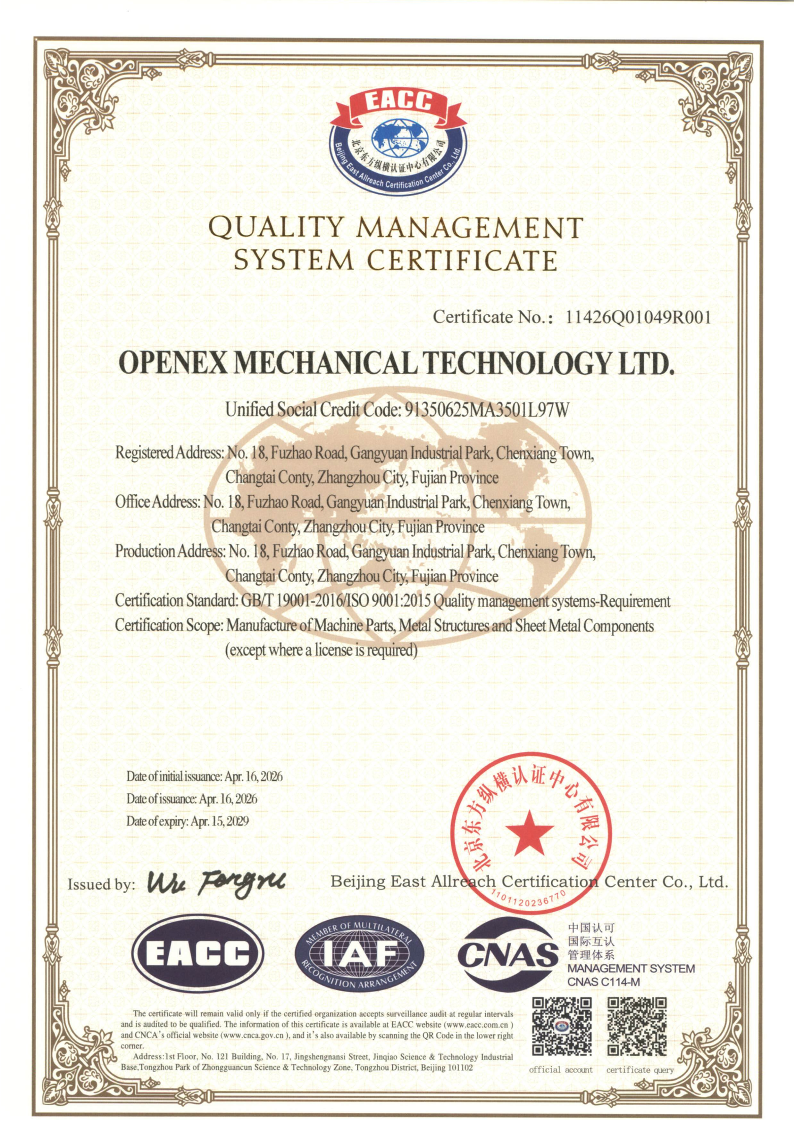
- ISO 9001:2015 — certificate number 11426Q01049R001, issued by Beijing East Allreach Certification Center Co., Ltd., based on GB/T 19001-2016 / ISO 9001:2015, valid from 2026-04-16 to 2029-04-15, applicable to the global market. Scope: manufacture of machined parts, metal structures and sheet metal components (except where a license is required).
- ISO 14001:2015 — certificate number 11426E00739R001, same issuing body and same validity window, standard GB/T 24001-2016 / ISO 14001:2015, same scope wording.
- ISO 45001:2018 — certificate number 11426S00656R001, same issuing body and validity window, standard GB/T 45001-2020 / ISO 45001:2018, covering the same manufacturing scope.
- ISO 3834-2 (EN ISO 3834-2) — certificate number 23/999-3834, issued by SGS, valid until 2026-10-04. Scope: fusion welding of metallic material, welding process 135 and 135-Auto, material groups 1.1 and 1.2.
Where the scope ends, and why that matters
Three limits are worth writing into a project file. First, the ISO 3834-2 certificate names process 135 and 135-Auto only. The shops also run SMAW, GMAW/MIG, GTAW/TIG, SAW, automatic tube-to-tubesheet welding, deep penetration welding and six-axis robotic welding cells with repeat positioning accuracy of ±0.05 mm, but those processes are not listed on this certificate, so procedure qualification records should be requested per project. Second, material groups 1.1 and 1.2 stop short of stainless steel, duplex and aluminium, so a 316L welded housing follows a different qualification path from a carbon steel weldment. Third, casting, forging, hot-dip galvanizing and powder coating are partner processes, and a certificate held by Openex should not be read as a certificate for those suppliers.
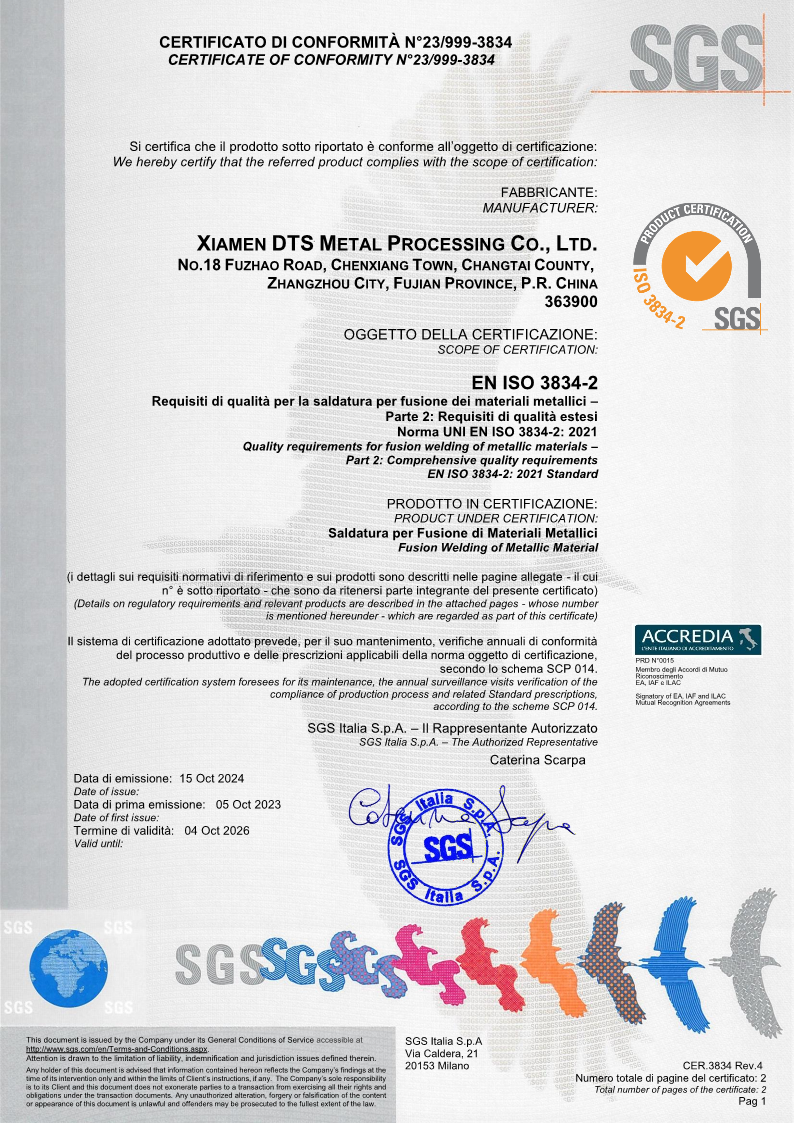
Because certificate 23/999-3834 expires on 2026-10-04, buyers placing orders in the fourth quarter of 2026 should ask for the current certificate copy to be attached to the quotation.
Pressure equipment is a separate case with its own documentation. Heat exchangers, feed surge drums, storage containers, regenerators and prefabricated pipe spools are produced under ASME-certified fabrication, with in-house non-destructive testing covering TOFD, phased array, RT, UT and MT, plus pressure testing where the design requires it. Buyers procuring for refineries, LNG or petrochemical service should request the applicable ASME documentation package alongside the ISO certificates, because the two answer different questions.
The physical envelope that actually constrains feasibility
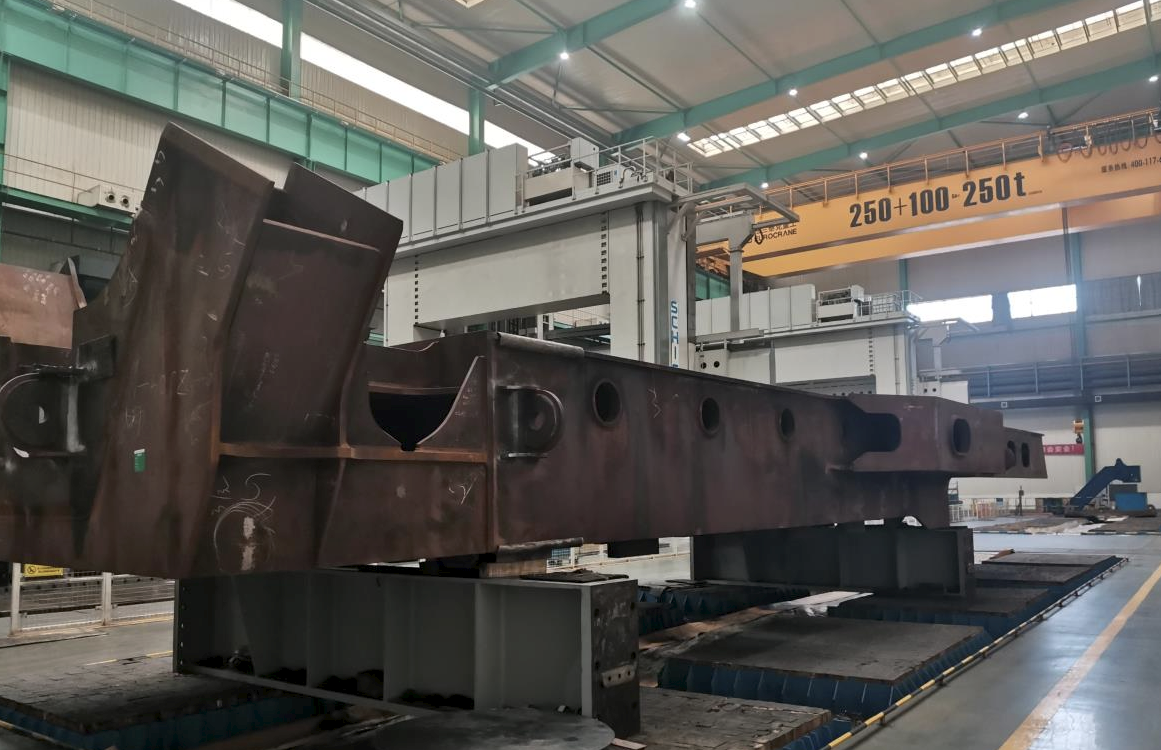
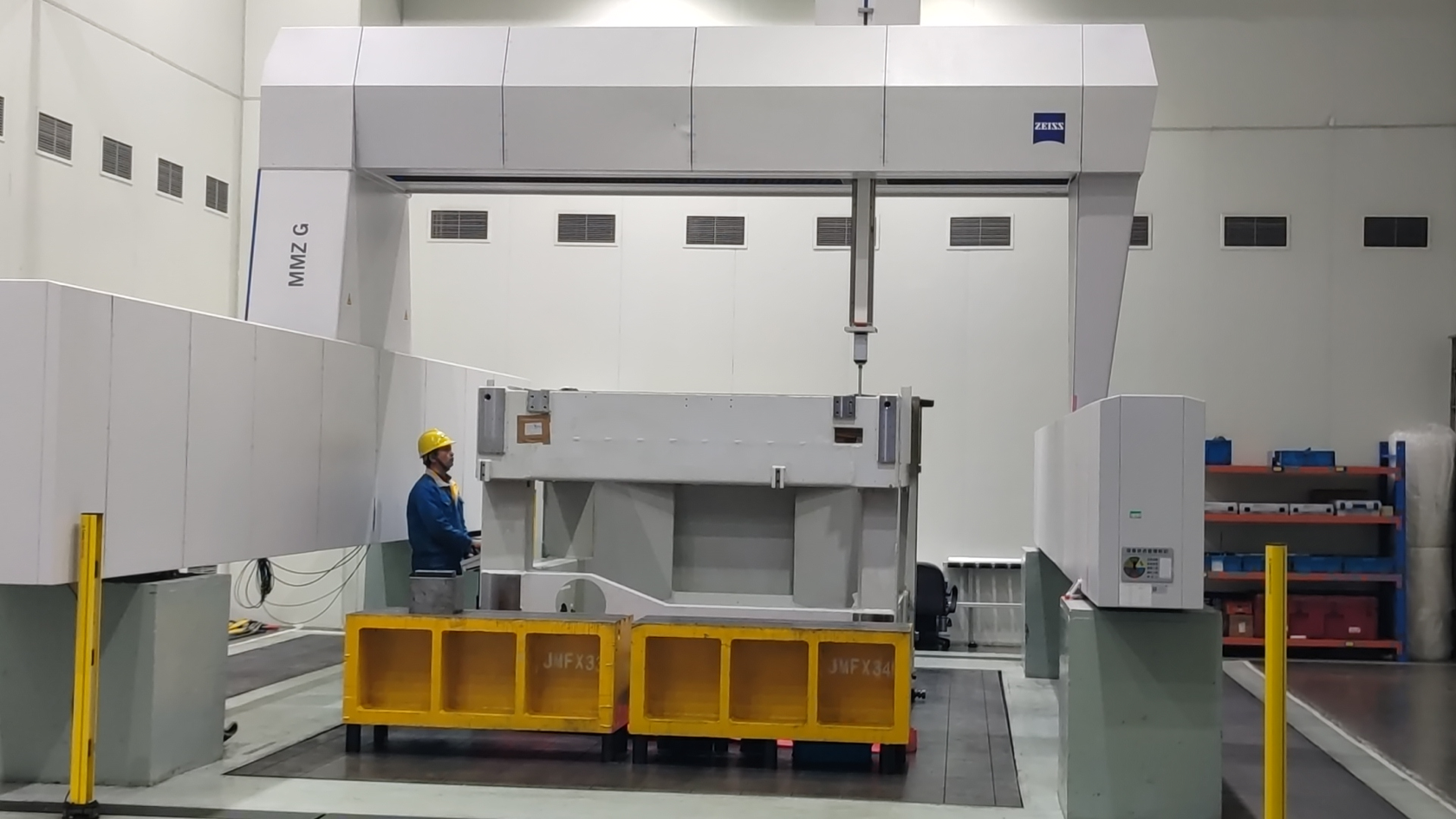
Certificate scope gets a supplier onto a shortlist; the machine envelope decides whether the part can be produced at all. Openex works with an overhead crane rated over 250 tons, press brakes with a maximum length over 18 m and tonnage over 10,000 tons, and CNC machine tools with maximum travel up to 50 m x 8 m x 7 m. Inspection is carried out on a Zeiss large CMM with 7 m x 4 m x 3 m capacity and micron-level precision, supported by smaller CMMs for lighter work.
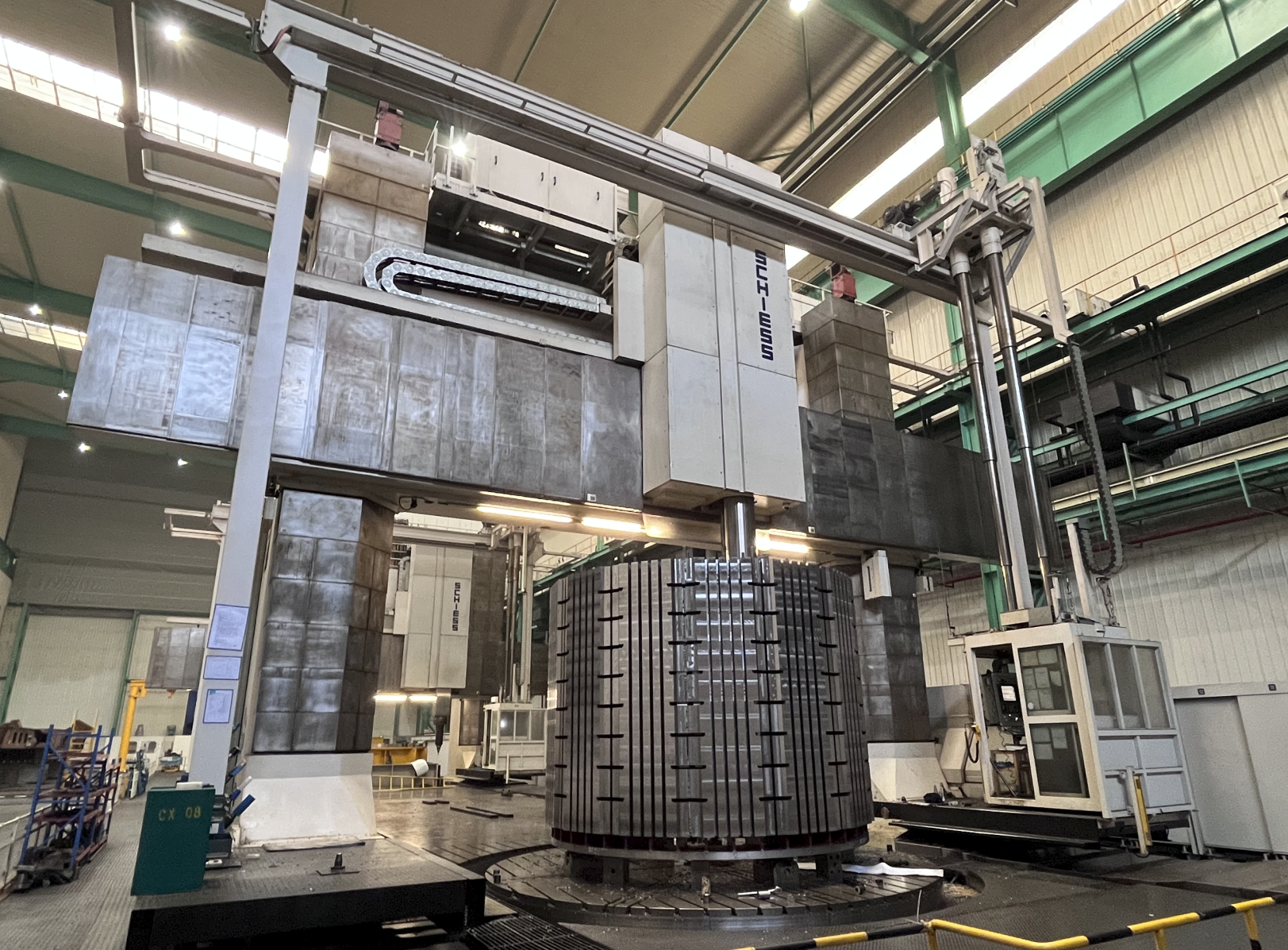
That envelope is what allows fabrication and finish machining to stay in one supply chain: cut, form, weld, stress-relieve, machine, inspect, coat and assemble, including spray painting, powder coating, electroplating and hot-dip galvanizing through qualified partner plants.
Step-by-Step: Seven Verification Steps Before You Award the Order
Step 1 — Read the scope sentence, not the logo
Request the certificate PDF rather than relying on a badge on a website. The operative text is the scope sentence. For ISO 9001 the scope reads: manufacture of machined parts, metal structures and sheet metal components (except where a license is required). Anything outside that description, such as a purchased proprietary unit that is only resold, is not covered.
Step 2 — Verify number, issuer and expiry independently
The four certificates to check are ISO 9001 (11426Q01049R001), ISO 14001 (11426E00739R001) and ISO 45001 (11426S00656R001), all issued by Beijing East Allreach Certification Center Co., Ltd. and valid from 2026-04-16 to 2029-04-15, plus ISO 3834-2 (23/999-3834) issued by SGS and valid until 2026-10-04. Confirm each one in the issuing body's register and put the renewal dates into the project schedule.
Step 3 — Match welding qualification to your material group and process
If the drawing specifies 304, 316L, duplex or aluminium, request welding procedure specifications, procedure qualification records and welder qualification documents for that material group. Do not assume coverage from a certificate whose scope names material groups 1.1 and 1.2.
Step 4 — Match the machine envelope to the part envelope
Compare the largest and heaviest item on your drawing list against lifting capacity, forming capacity, machining travel and inspection capacity. The current ceiling is an overhead crane rated over 250 tons, press brakes over 18 m and over 10,000 tons, CNC travel up to 50 m x 8 m x 7 m, and a CMM with 7 m x 4 m x 3 m capacity.
Step 5 — Separate in-house operations from subcontracted ones
Ask for a routing table showing which operations run inside the two Openex premises and which come from partners. For casting, forging, galvanizing and powder coating, confirm who the partner is and what documentation travels with the parts.
Step 6 — Fix the inspection and documentation plan before the first cut
Available non-destructive testing includes RT, UT, MT, PT, VT and LT, with TOFD and phased array for heavy-wall welds. Destructive testing covers chemical analysis, tensile testing (ultimate tensile strength, yield, elongation), impact testing including low temperature, bend testing for ductility and hardness testing, plus salt spray corrosion testing. Dimensional work is measured on CMM with surface roughness parameters such as Ra and Rz reported as required. Welding documents can include WPS, PQR, welder qualification and post-weld heat treatment procedures. Inspection can be 100% or sampling depending on the requirement, and that choice should be written down rather than assumed.
Step 7 — Agree the drawing pack, sample route and lead time
Accepted drawing formats are STEP, IGES, DWG, DXF and PDF. A 2D drawing together with a 3D model gives the fastest quotation; 2D alone is workable for simple parts; 3D alone is rarely sufficient. Fabrication lead time is typically 30–45 days and coating 45 days. For heavy parts, the sample is normally a first article with dimensional and NDT documentation rather than a shipped unit.
Use Cases: Four Applications Where Certification and Tolerance Decide
1. Heat transfer and pressure equipment
Tube sheets for a power plant heat exchanger in Indonesia illustrate the pattern: a 45-ton package drilled on a multi-spindle CNC fleet to ±0.05 mm, with quality assurance covering CMM measurement, UT, PT, MT and PMI inspection, and remote pre-shipment inspection before dispatch. Heat exchangers are available in shell-and-tube, fixed tube sheet, floating head, double tube sheet and spiral-wound configurations, fabricated under ASME-certified fabrication from carbon steel, stainless steel, duplex, titanium and corrosion-resistant alloys including Inconel, Monel and Hastelloy.
2. Energy storage and renewable power
Flywheel energy storage shells are a vacuum constraint rather than a dimensional one: 400 units supplied, with each shell required to hold better than 1.0 x 10⁻⁹ Torr L/s within 30 seconds, and the fleet reported in stable operation for five years. Steel shelves and boxes for lithium-battery energy storage systems are a coating and assembly constraint instead: units of 1.1 m x 1.1 m x 2.2 m at about 1,000 kg each, powder coated against rust, with 300 units reported free of rust, leakage and deformation. Wind tree structures for wind power combine cutting, bending, machining, welding, hot-dip galvanizing and powder coating across a 300-ton program, with pre-assembly used to verify manufacturing precision before disassembly and packing.
3. Port, logistics and bulk handling equipment
Steel chassis for container AGVs are a load and welding constraint: 345 units supplied to a Netherlands-based AGV builder, each 15 m x 2.7 m x 3 m and 10.5 tons, with a 30-ton load capacity, fabricated from 25 mm S355JR (or ASTM A572 Grade 50) high-strength plate and 20 mm NM400 abrasion-resistant plate in wear areas. Steel coil pallets for a Japanese steel mill are a different problem: 30 units at 15 m x 2.5 m x 2.1 m and 10 tons each with a 35-ton maximum load, using a V-shaped top with wooden cushioning to protect the coil surface during storage and transfer.
4. Machinery frames and precision bases
Milling machine centre frames show why fabrication and finish machining belong together: model DM-2608, 2 m x 2 m, carbon steel, made to order to 0.01 mm per 1 m precision and verified on CMM. Robot bases and large machine bases follow the same logic — welded steel structures, stress-relieved and shot-blasted, with ground top plates held to ±0.001 in cumulative flatness on the B-300 range, available from 24 in x 24 in up to 72 in x 96 in.
Constraint Tables for Your RFQ
These tables are built only from published certification and specification data for Openex products and programs. They are the fastest way to check whether a project sits inside or outside the certified and documented envelope.
Table 1 — Certification register and scope
| Certificate | Standard | Issuing body | Number | Scope | Validity |
|---|---|---|---|---|---|
| ISO 9001 | GB/T 19001-2016 / ISO 9001:2015 | Beijing East Allreach Certification Center Co., Ltd. | 11426Q01049R001 | Manufacture of machined parts, metal structures and sheet metal components (except where a license is required) | 2026-04-16 to 2029-04-15 |
| ISO 14001 | GB/T 24001-2016 / ISO 14001:2015 | Beijing East Allreach Certification Center Co., Ltd. | 11426E00739R001 | Manufacture of machined parts, metal structures and sheet metal components (except where a license is required) | 2026-04-16 to 2029-04-15 |
| ISO 45001 | GB/T 45001-2020 / ISO 45001:2018 | Beijing East Allreach Certification Center Co., Ltd. | 11426S00656R001 | Manufacture of machined parts, metal structures and sheet metal components (except where a license is required) | 2026-04-16 to 2029-04-15 |
| ISO 3834-2 | EN ISO 3834-2 | SGS | 23/999-3834 | Fusion welding of metallic material (welding process 135, 135-Auto; material groups 1.1, 1.2) | Until 2026-10-04 |
Table 2 — Dimensional and quality constraints by product family
| Product family (model) | Key dimensional constraint | Quality assurance |
|---|---|---|
| Tube sheet (Customized-J-01) | Diameter up to 10,000 mm; thickness up to 600 mm; drilling depth up to 1,000 mm; drilling precision ±0.05 mm | CMM measurement, UT, PT, MT and PMI inspection; multi-plate simultaneous drilling |
| Large box vacuum chamber (Custom-L-9) | Internal size 2,000 x 1,500 x 1,500 mm; nominal wall 12 mm with external stiffeners; design vacuum ≤1 x 10^-5 mbar | Helium leak rate ≤1 x 10^-8 mbar L/s after final testing; port layout to approved drawings |
| Heavy equipment skid (Custom-L-6) | Reference size 8,000 x 3,000 x 1,200 mm; design equipment load 30–60 t; ASTM A36 / A572 Grade 50 / SS304 | Mounting-pad flatness ≤0.20 mm per 1,000 mm |
| Heavy machine base (B-300) | Base size 24 x 24 in to 72 x 96 in; top plate 1, 1.5 or 2 in; ASTM A36 with optional SS304 or aluminium | Welded, stress-relieved and shot-blasted; ground-top flatness ±0.001 in cumulative |
| Ultra-long formed steel box section (Custom-L-1) | Overall length 8,000 mm; plate thickness 6 mm; unit mass 1.5 t; Q355B / S355J2+N / A572 Grade 50 | Overall straightness ≤3.0 mm per 10,000 mm |
| Telescopic boom (Customized-J-04) | Q960 / BS700MCK2 high-strength steel; painting or powder coating | Straightness tolerance ±1 mm; height difference <1.5 mm |
| Rotary mill shell (Customized-E-08) | Diameter 8–12 m; plate thickness 40–100 mm; S355J2 / SA516 Gr70 / Q355B | Heavy plate rolling, full-penetration welding, large-scale machining and comprehensive NDT |
| Large welded press frame (Custom-L-3) | Reference press force 10,000–20,000 kN; envelope approx. 6,000 x 4,000 x 8,000 mm; main plate 60–120 mm | Press force and frame dimensions require FEA and fatigue assessment |
Table 3 — Fabrication, machining and coating program limits
| Program | Monthly capacity | Minimum order quantity | Lead time |
|---|---|---|---|
| Welding fabrication | 5,000 tons | 25 tons | 30–45 days |
| Machining | 3,000 tons | 15 tons | 30–45 days |
| Surface treatment and coating | 3,000 units | 15 tons | 45 days |
FAQ: ISO 9001 Certified Metal Fabrication Manufacturers
Are you an ISO 9001 certified metal fabrication manufacturer, and what exactly does the certificate cover?
Yes. Xiamen Openex Mechanical Technology Ltd holds ISO 9001 certification with certificate number 11426Q01049R001, issued by Beijing East Allreach Certification Center Co., Ltd. under the standard GB/T 19001-2016 / ISO 9001:2015. The certificate is valid from 2026-04-16 to 2029-04-15 and applies to the global market. Its scope is the manufacture of machined parts, metal structures and sheet metal components (except where a license is required), which covers fabricated and machined metal work packages rather than distribution of finished goods. The same company also holds ISO 14001 (certificate 11426E00739R001) and ISO 45001 (certificate 11426S00656R001) under the same scope and validity window.
Which welding certification do you hold, and which processes and material groups does it cover?
Openex holds ISO 3834-2 certification, certificate number 23/999-3834, issued by SGS under the standard EN ISO 3834-2 and valid until 2026-10-04. The certified scope is fusion welding of metallic material with welding process 135 and 135-Auto, in material groups 1.1 and 1.2. Process 135 is gas-shielded solid-wire welding, usually called MIG/MAG, and material groups 1.1 and 1.2 correspond to the common carbon and low-alloy structural steel families. Stainless steel such as 304 or 316L, duplex grades and aluminium fall outside this certificate scope, so buyers of those parts should request welding procedure specifications, procedure qualification records and welder qualification documents for the specific material group instead of relying on this certificate.
What dimensional and size limits can you hold on large fabricated and machined parts?
The limits come from lifting and forming equipment, machining travel and inspection capability. Openex operates an overhead crane rated over 250 tons, press brakes with maximum length over 18 m and tonnage over 10,000 tons, and CNC machine tools with maximum travel up to 50 m x 8 m x 7 m. Inspection uses a Zeiss large CMM with 7 m x 4 m x 3 m capacity and micron-level precision, supported by smaller CMMs. Documented examples inside that envelope include tube sheets up to 10,000 mm diameter and 600 mm thickness drilled to ±0.05 mm, a large box vacuum chamber of 2,000 x 1,500 x 1,500 mm with a design vacuum of ≤1 x 10^-5 mbar and a helium leak rate of ≤1 x 10^-8 mbar L/s, and rotary mill shells of 8 to 12 m diameter in 40 to 100 mm plate.
What determines the cost of a custom metal fabrication order, and what is the minimum order quantity?
Four commercial drivers dominate: container utilisation, because FCL shipment costs less per part than LCL; how much fixed overhead is spread across the quantity; the material purchase price achievable at higher volumes; and whether the part repeats, since repeat orders support stable pricing and consistent quality. The published program limits are welding fabrication MOQ 25 tons with 30–45 days lead time, machining MOQ 15 tons with 30–45 days lead time, and surface treatment and coating MOQ 15 tons with 45 days lead time, against monthly capacities of 5,000 tons, 3,000 tons and 3,000 units respectively. Very small parts in very small quantities are therefore not the most efficient use of this supply route, while large or heavy parts in modest quantities can be a good fit when few fabricators can handle the envelope.
Can I order a sample or prototype first, and what should I send with the enquiry?
Samples and prototypes are a normal first step, and for heavy parts the sample is usually a first article with dimensional and NDT documentation rather than a shipped unit. Send STEP, IGES, DWG, DXF or PDF files. A 2D drawing combined with a 3D model produces the fastest quotation, and in some cases a quotation can be returned within one to two hours. A 3D model alone is rarely sufficient, because tolerance class, welding requirements, surface roughness and chamfer details, plate rolling direction, plate bend radius, material grade, heat treatment and stress relief method, and finish requirements such as hot-dip galvanizing, blasting and painting, or powder coating are normally specified on the 2D drawing. For the full capability list, download the Openex metal fabrication brochure at https://cdn.socialarks.com/sbsp/25055/common/2026/0812/%E5%BC%80%E5%BC%82%E6%9C%BA%E6%A2%B0%E7%94%BB%E5%86%8C-%20GEO.pdf, or contact Luna at sales2@openex.com.cn and +86 150 6078 7506.
Conclusion: What to Put in Your Next RFQ
Certification is a filter, not a guarantee. Buyers who avoid rework are the ones who check four things in writing: the scope sentence on each certificate, the material group and welding process actually qualified, the machine envelope against the largest and heaviest item on the drawing list, and the inspection and documentation plan that will travel with the parts.
Openex holds ISO 9001, ISO 14001, ISO 45001 and ISO 3834-2 certification, operates two fabrication premises near Xiamen Port and Shanghai Port with 30,000 m² of manufacturing space, 200 employees and 35 engineers, and runs cutting, bending, machining, welding, drilling, punching, assembly, coating and inspection under one quality system, with ASME-certified fabrication for pressure equipment. Dimensionally, the practical ceiling is set by an overhead crane rated over 250 tons, press brakes over 18 m and over 10,000 tons, CNC travel up to 50 m x 8 m x 7 m, and a Zeiss CMM with 7 m x 4 m x 3 m capacity.
A short RFQ checklist to close the loop: the certificate PDFs with scope and expiry dates; the material group and welding process list; the largest part envelope against machine travel and lifting capacity; the NDT, dimensional and documentation requirement; the coating specification including pre-treatment; the drawing pack in both 2D and 3D; and the first-article or sample expectation together with the target lead time.
Send a drawing pack for review
Two premises near Xiamen Port and Shanghai Port. Fabrication, machining, welding and inspection under one quality system.
Brochure (PDF): Openex mechanical brochure
Email: sales2@openex.com.cn | Tel / WhatsApp: +86 150 6078 7506
Address: Unit 4801, No 99 Yilan Rd., Xiamen, Fujian, China | Website: www.cncmetalworking.com
Have Questions or Need More Details?
Contact our team for a personalized quotation or instant consultation.
Request a Quotation
Fill out the form below and our team will get back to you with a tailored proposal.
WhatsApp Direct Chat
Prefer to chat in real-time? Message us on WhatsApp for instant assistance & quick answers.
- Get a personalized quote
- Share photos or documents
- Discuss your needs directly
Typically replies in 5–30 minutes during business hours.