
Hydropower Turbine Ring Fabrication: Material, Welding, Machining Specs
The short answer: a turbine ring specification should lock five things before a fabricator quotes — the material route and grade, the welding procedure with its NDT acceptance, the split-joint design, the machining tolerances for assembled-ring roundness and flange fit, and the transport envelope. Fixturing, weld sequencing and lifting plans are the fabricator's method. Those five items are the buyer's responsibility, and they are what separate a quote that can be executed from one that has to be renegotiated after the first segment is rolled.
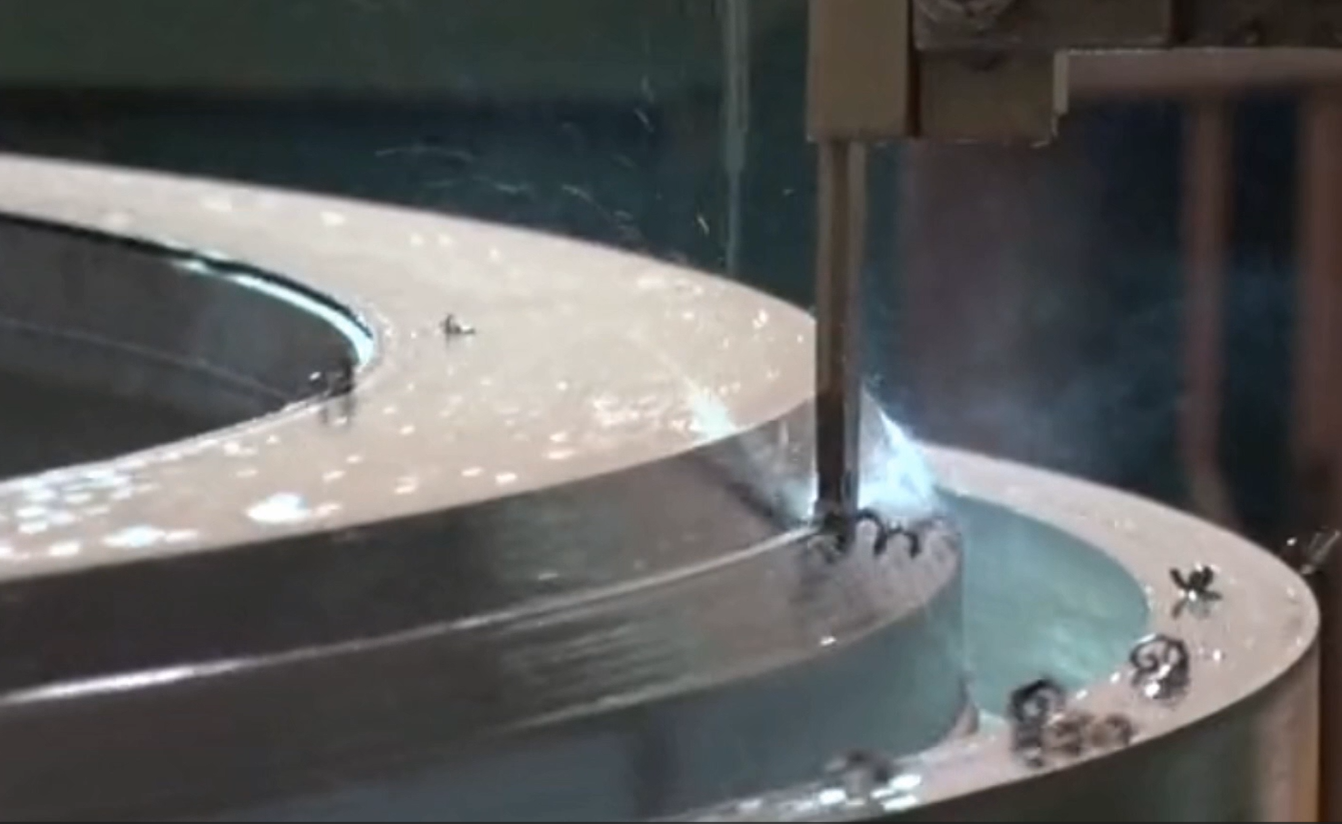
Problem definition: turbine rings fail at the interface, not in the workshop
A turbine ring is a fit-critical part, not a general weldment. Its bore, flange faces and bolt pattern have to meet interfaces that already exist on site — stay ring, runner, draft tube, gate operating ring — and on a rebuild those interfaces are the original ones. The civil structure stays; the ring has to adapt to it.
Most ring problems trace back to four specification gaps rather than to fabrication skill:
- The specification stops at material and drawing. NDT acceptance, heat-treatment state and the point at which final machining happens are left implicit, so the fabricator picks a default that may not match the station's design basis.
- Split-joint design is deferred. The number of segments, whether joints are bolted or welded, and whether joint faces are machined are decided after rolling instead of before.
- Machining is planned per segment. Segment-level tolerances do not add up to an assembled-ring roundness figure, so the ring does not close on site.
- Transport and lifting limits are checked last. A ring that can be machined may still not fit a shipping frame or the site crane.
The practical consequence is familiar to project engineers: segments arrive, the joint faces need field shimming, bolt holes need reaming, and the schedule slips in exactly the phase where the station is already offline.
Industry background: why ring specs are getting stricter
Hydropower refurbishment keeps a steady demand line for large ring-shaped components, and the material mix in heavy fabrication remains dominated by steel. Aggregated commercial research for 2024 places steel at 63.2% of material share in North American fabricated metal services, with structural and heavy frames as the main application block (Report Insight / Mordor, aggregated, 2024). That matches what ring drawings look like in practice: carbon and low-alloy steel plate, with cast or forged blanks where the geometry leaves no room for a weld.
The fabrication base itself has changed. In 2024, roughly 48% of fabrication output was reported to run on CNC cutting, robotic welding and laser processes (Market Research Insights, 2024). That matters to buyers because it sets a floor on what can reasonably be requested: robotic and CNC-backed shops can hold repeatable geometry and document it, while manual-only shops cannot produce the same dimensional report trail.
On the compliance side, welding qualification is not a local convention. ASME BPVC Section IX governs welding and brazing qualification internationally, and European and export projects typically reference EN ISO 3834-2 for the welding quality system alongside it. A ring quote that does not name which of these frameworks applies is unresolved at the document level, whatever the price says.
Detailed solution: the four parameters buyers actually control
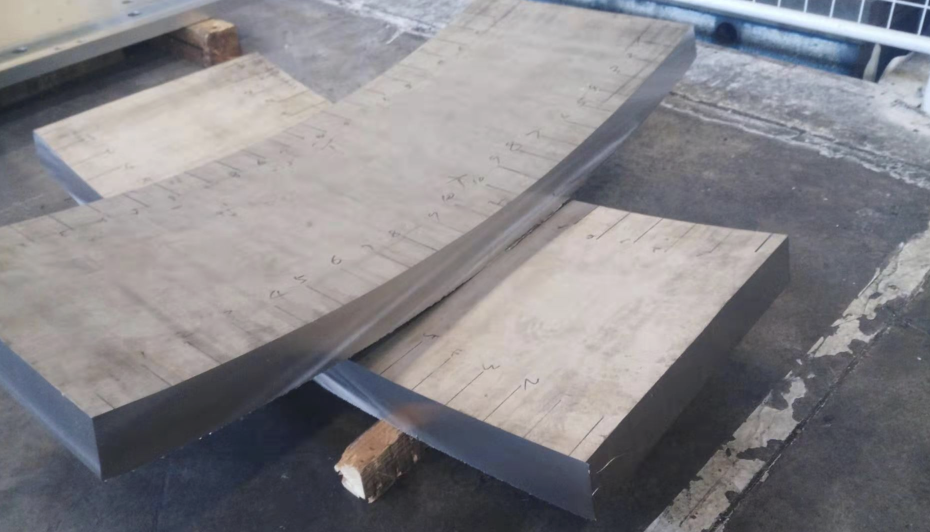
1. Material selection for large carbon steel rings and cast components
Two routes cover nearly every ring drawing: formed-and-welded construction from steel plate, or a cast or forged blank that is subsequently machined. The welded route keeps material certificates simple and moves the risk into welding and heat treatment. The cast route moves the risk into pattern, casting soundness and repair-welding policy.
For the welded route, the base-material range matters more than the grade name. A fabricator that routinely works carbon steels, low-alloy steels, stainless steels, duplex and super duplex, and clad or composite plates can follow a grade change on a drawing without re-qualifying its whole process set. Chemistry verification should be explicit: chemical analysis on element composition is a standard destructive test in a properly equipped shop, and it is the cheapest way to confirm that the plate heat number on the mill certificate is the plate that was cut.
For the cast route, the buyer needs three answers before the blank is ordered: which casting specification governs soundness, whether repair welding is permitted and under which procedure, and which surfaces are left with machining allowance. Openex fabrication — Xiamen Openex Mechanical Technology Ltd, a custom metal fabrication and machining supplier founded in 2009 with manufacturing premises near Xiamen Port and Shanghai Port — includes casting and forging in its process range, including iron and steel castings, so a cast ring blank and its subsequent machining can be placed under one quality system rather than split across two suppliers.
2. Welding procedure and NDT expectations
A ring specification should name the welding processes permitted, the qualification documents required, the heat-treatment state, and the NDT method-by-joint matrix. Anything left unnamed becomes the fabricator's default.
The document set to require is consistent across frameworks: a written WPS, the supporting PQR, welder qualification records for each process and position used, and a PWHT procedure where heat treatment applies. The process menu at a heavy fabrication shop typically spans SMAW, GMAW/MIG, GTAW/TIG and SAW, plus robotic welding for repetitive seams and deep-penetration welding where full-joint penetration is specified. Joint preparation details — bevel angle, root gap, land thickness — belong on the drawing or in the approved WPS, not in a verbal agreement.
NDT is where most ambiguity sits. A complete method list includes visual inspection, dimensional check, RT, UT, MT, PT, TOFD or phased array, hardness testing, hydrostatic or pneumatic testing, and corrosion testing. On a turbine ring the useful specification is not the list but the matrix: which joint, which method, what coverage percentage, and at which stage — root pass, completed weld, or after post-weld heat treatment.
3. Machining tolerance planning for ring roundness and flange fit
The single most consequential machining decision on a split ring is when final machining happens. Machining each segment to final size and then bolting the ring together produces a stack-up of segment errors that no field adjustment can remove. The working sequence is to rough machine the segments, assemble them in the same bolted condition used on site, and then carry out final precision machining on the complete ring.
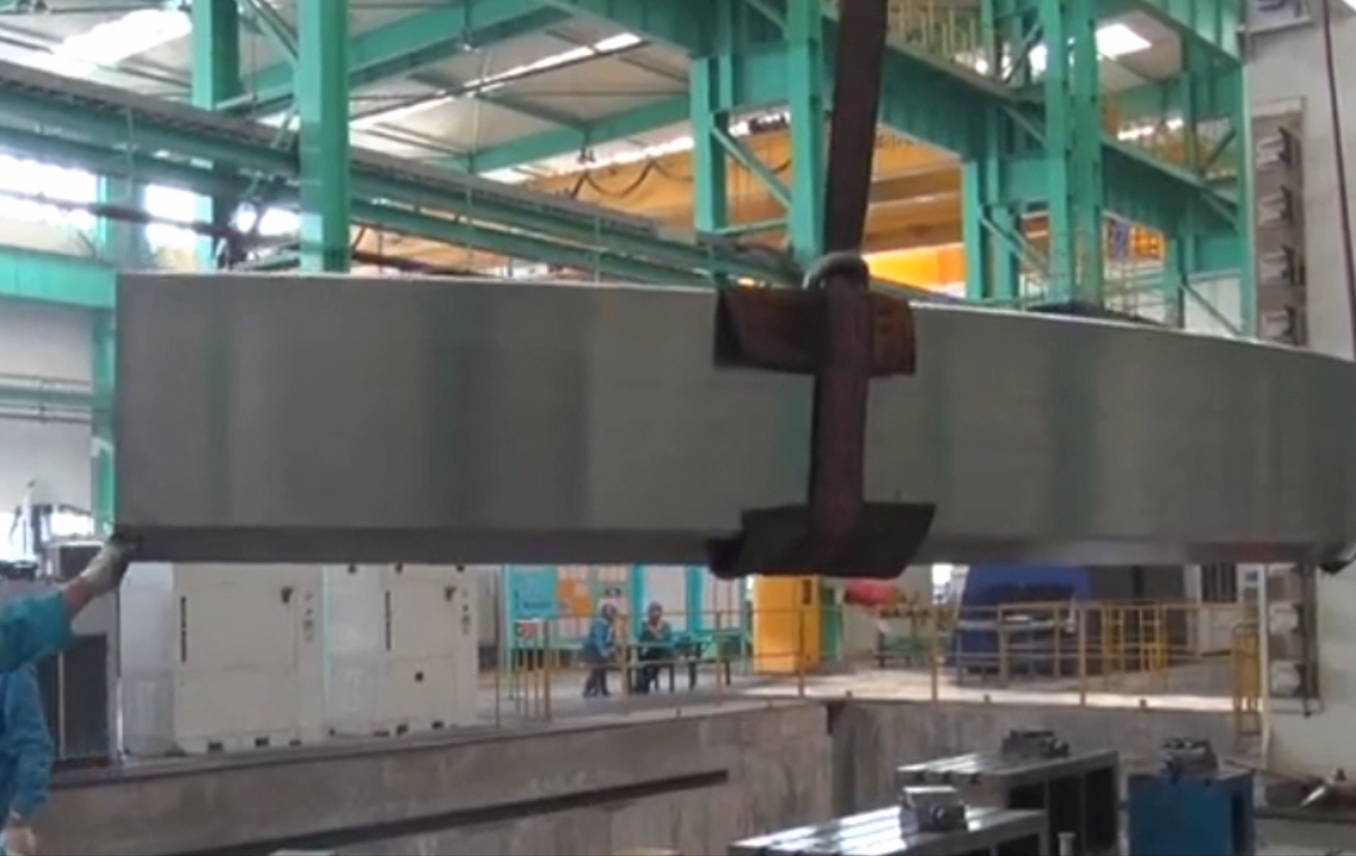
That sequence was used on a 30-ton turbine ring for a hydropower station in Uruguay, where the segments were separated for rough machining and then recombined for final precision machining to hold the tight tolerance required at the assembled condition. Final turning on the complete ring is what converts segment geometry into ring geometry.
The tolerance set to write into the specification, rather than leaving to shop default, is:
- Circularity / roundness of the ring bore in the assembled, bolted condition.
- Cylindricity where the bore has significant axial length and the runner fit depends on it.
- Flatness of flange and joint faces, measured before and after bolt tightening.
- Position of bolt holes relative to the ring datum, not relative to individual segments.
- Concentricity between the ring bore and the flange register.
- Surface roughness stated as Ra or Rz on sealing and fit surfaces.
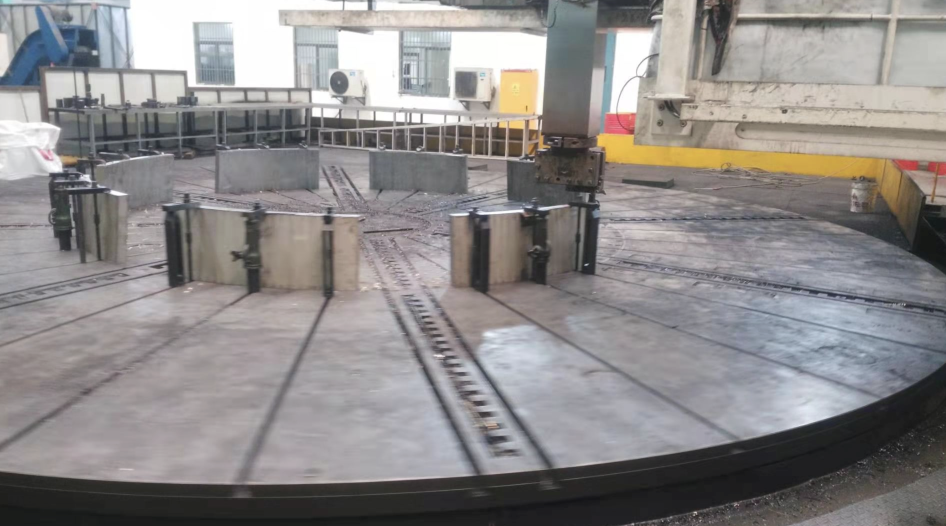
Capacity then has to match the tolerance plan. Large horizontal and vertical turning, boring, drilling and milling in a single setup avoid re-clamping error on a part that cannot be re-set cheaply. For reference, the Wuzhong single-column CNC turning and milling centre CKX53220 x65/600 handles a maximum machining diameter of 22 m, a maximum workpiece load of 600 t and a maximum workpiece height of 6.5 m, with turning, milling, boring, drilling, tapping and finishing supported in one machine. Verification is the other half of the plan: a Zeiss large CMM with 7 x 4 x 3 m capacity and micron-level precision supports the dimensional report, alongside the standard dimensional checks for length, diameter, angle, roundness, straightness and position.
4. Sizing the forming route against the casting route
Route selection is arithmetic before it is metallurgy. Ring outside diameter versus available plate width determines the minimum segment count; ring weight versus crane capacity determines the maximum segment weight; and ring wall thickness versus weld access determines whether welding is practical at all.
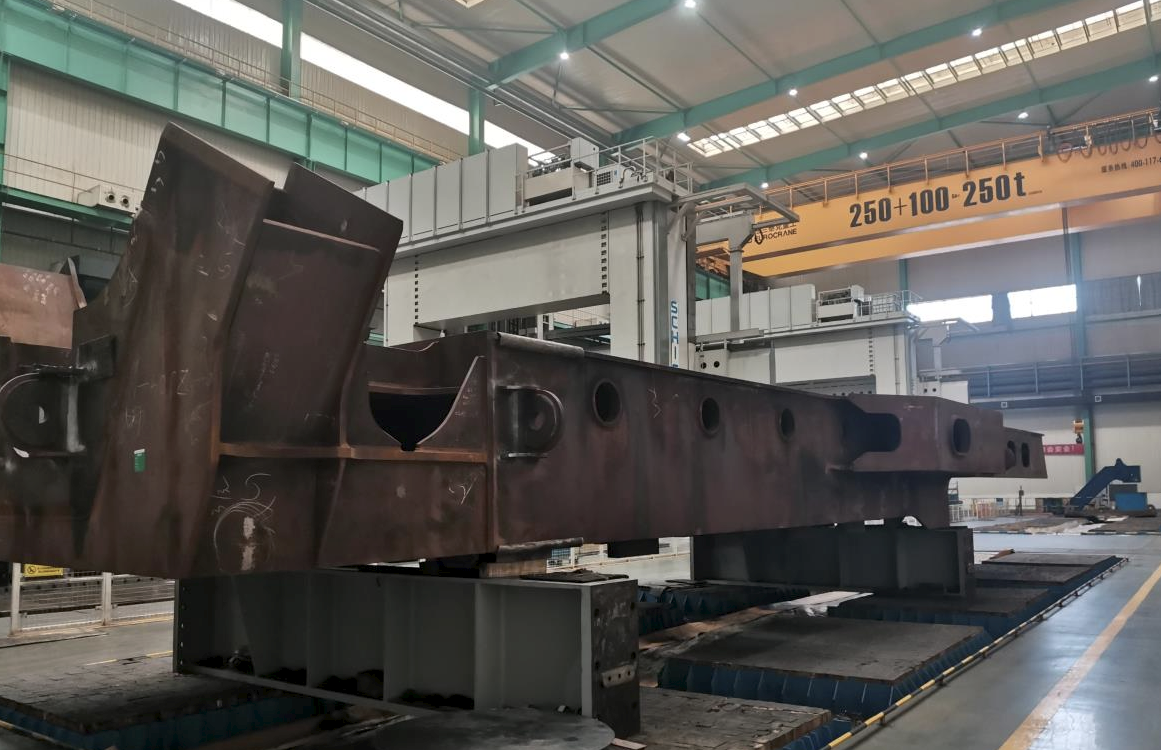
Forming capacity sets the ceiling on the welded route. Heavy plate rolling and bending equipment in the range of 18 m length and up to 10,000 t, served by overhead cranes above 250 t, is what allows large-diameter rings to be formed and handled as segments rather than as one piece. Where the ring diameter exceeds usable plate width, splitting is not optional — it is forced, and the split-joint design then becomes the critical drawing detail.
The casting route wins when the section is thick, the geometry has compound curvature, or the drawing already derives from a casting. It loses time at the front end because pattern work and casting lead time sit ahead of any machining, and it adds a repair-welding policy question that the welded route does not have.
Step-by-step breakdown: from drawing to shipped ring
- Freeze the interface drawing. Confirm the mating dimensions that already exist on site. On a rebuild, measure or scan the stay ring and flange faces before the new ring is modelled.
- Choose the material route and grade. Plate-and-weld or cast blank, with the governing material standard, required mechanical testing and chemistry verification stated.
- Decide split count and joint design. Bolted joints need machined joint faces and a torque specification; weld-together joints need a weld procedure and NDT coverage at the closure seam.
- Approve WPS, PQR and welder qualification. Add the PWHT procedure if heat treatment is required, and state whether PWHT precedes or follows final machining.
- Rough machine the segments. Leave machining stock sized for the distortion expected from welding and heat treatment, not a nominal allowance.
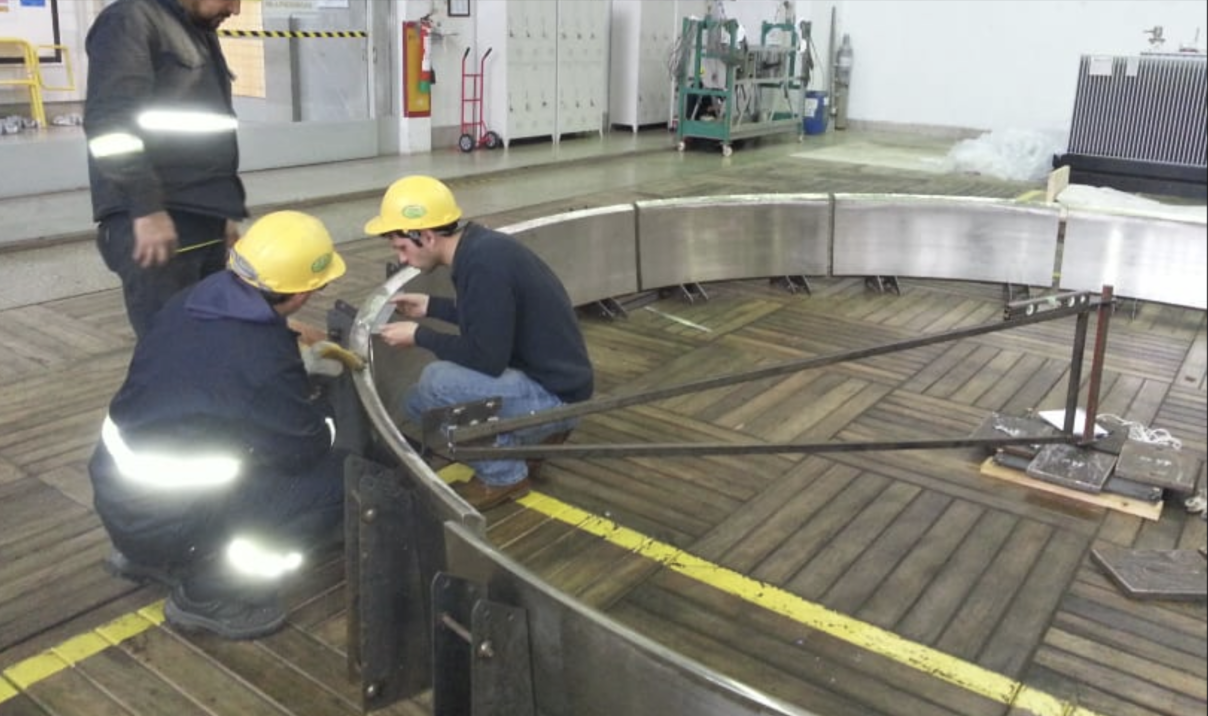
- Assemble the segments. Bolt to the specified torque, or weld with a controlled sequence and a distortion control plan, then verify that the ring closes and the joints seat.
- Final machine the assembled ring. Turn and mill the bore, flange faces and bolt pattern in one setup where capacity allows.
- Inspect and document. NDT per the joint matrix, dimensional report per the tolerance set, hardness checks where PWHT applies, and a trial fit if the interface risk justifies it.
- Preserve, pack and plan the lift. Define lifting points, shipping frames and match marks so the ring can be reassembled or installed without re-machining.
Use cases: where the split-ring method earns its cost
Station rebuild with restricted access. The clearest case for a split ring is a rebuild where the intake or powerhouse opening will not accept a full ring. Segments pass the opening, are assembled inside, and are machined either in the shop in the assembled condition or finished on site. The Uruguay project — a 30-ton turbine ring for a hydropower station, specified against a 20-year service life — used the split method with the segments recombined for final precision machining, and the operator reports stable operation.
Replacement ring on an unchanged civil structure. When the surrounding concrete stays and only the ring is replaced, the new ring must adapt to old interfaces. Machining in the assembled bolted condition is the only way to guarantee that the bolt pattern and flange register match the as-built condition rather than the drawing condition.
Large machined components with remote inspection. Rings are rarely inspected in person by the buyer's engineer. A remote QC protocol — dimensional report plus photo and video records before shipment — has been used on comparable heavy work, including 45 tons of tube sheets for a power plant heat exchanger in Indonesia, where remote inspection was completed before shipping. The same protocol applies to a ring when travel is not practical.
Comparison table: rolled-and-welded, cast or forged ring route
| Selection criterion | Rolled and welded from steel plate | Cast blank, then machined | Forged blank, then machined |
|---|---|---|---|
| Geometry it suits | Ring sections that can be rolled and welded with access to both sides of the seam | Thick sections and compound curvature where a weld would sit in an inaccessible or highly stressed region | Heavy, compact sections requiring directional properties |
| Material range | Carbon steels, low-alloy steels, stainless steels, duplex and super duplex, clad and composite plates | Iron and steel castings to the specified casting standard | Forged steel to the specified forging standard |
| Main technical risk | Weld quality, distortion and residual stress; controlled by WPS, sequence and PWHT | Casting soundness and repair-welding policy | Lead time and machining allowance planning |
| NDT burden | Weld-by-weld: RT, UT, MT, PT, TOFD or phased array as specified | Volume inspection of the casting plus weld NDT on any repair | Inspection of the forging plus final machined-surface checks |
| Schedule driver | Plate procurement, forming, welding and PWHT | Pattern making and casting lead time before any machining | Forging lead time before any machining |
| Best fit for a turbine ring when | The ring can be split into transportable segments and joints can be machined | The drawing originates as a casting or wall thickness rules out welding | The section is heavy and dimensional stability is the priority |
Ranked: five parameters that decide ring acceptance
Buyers often ask which parameters matter most when the specification has to be shortened for a tender. Ranked by the cost of getting them wrong after shipment, the order is consistent:
- Assembled-ring roundness and flange flatness. Highest rank because it is the one property that cannot be corrected on site. A ring that is out of round in the bolted condition has to be re-machined or scrapped.
- Weld quality and NDT acceptance. Second because weld repairs after PWHT and final machining reopen both the process and the tolerance.
- Material identity and traceability. Third because an unverified heat number invalidates every downstream test, even when the part measures correctly.
- Split-joint fit and bolt-hole position. Fourth because misalignment shows up immediately at assembly and is expensive but recoverable.
- Surface finish and preservation. Fifth because roughness on a sealing face is a commissioning problem rather than a structural one.
Non-negotiable versus quote-changing parameters
The practical question at quotation stage is which specification changes alter the price and which must be held regardless. The table below separates them.
| Parameter | Status | Why |
|---|---|---|
| Material grade with certificate and chemistry verification | Non-negotiable | Substitution invalidates mechanical testing and NDT baselines |
| WPS, PQR and welder qualification records | Non-negotiable | Without them the weld is unqualified regardless of appearance |
| NDT acceptance criteria per joint | Non-negotiable | Defines rejection, not just inspection |
| Final machining in the assembled and bolted condition | Non-negotiable for split rings | Segment-level tolerances do not sum to ring-level roundness |
| Number of segments and joint type | Quote-changing | Each additional joint adds machining, NDT coverage and assembly time |
| Post-weld heat treatment and its position in the sequence | Quote-changing | PWHT before final machining requires re-clamping and an extra machining allowance cycle |
| NDT scope expansion (TOFD or phased array, additional coverage) | Quote-changing | Inspection time and reporting load scale with coverage |
| Third-party or buyer witness inspection | Quote-changing | Adds hold points and schedule dependency |
| Transport envelope and lifting points | Quote-changing | Drives segment weight limits, frames and packing design |
FAQ
Which documents should accompany a turbine ring quotation for compliance review?
A reviewable quotation package should include the material certificate with heat numbers, the WPS and the supporting PQR, welder qualification records for each process and position used, the PWHT procedure if heat treatment applies, the NDT method and acceptance matrix, and the certificate for the welding quality system with its current validity dates. Quality management certification should be current and its scope should cover machined parts and metal structures; Openex's ISO 9001 certificate 11426Q01049R001 is valid from 2026-04-16 to 2029-04-15 with that scope.
What is the largest turbine ring that can be machined after assembly?
It depends on the machine, not on the welding side. The Wuzhong single-column CNC turning and milling centre CKX53220 x65/600 supports a maximum machining diameter of 22 m, a maximum workpiece load of 600 t and a maximum workpiece height of 6.5 m, with turning, milling, boring, drilling, tapping and finishing in one setup. A split ring that exceeds these limits must be machined in segments and finished on site, which changes the tolerance plan.
Which parameters change a turbine ring price the most?
Four items move a quote more than material grade does: the number of segments and joint type, whether post-weld heat treatment is required and where it sits in the sequence, the NDT coverage matrix, and whether final machining is performed on the assembled ring. Adding a joint, adding PWHT before final machining, or expanding NDT to full TOFD coverage each add a separate operation rather than a percentage.
Can a fabricator prove the process before the full ring is produced?
Yes, and the evidence should be staged. Welded test pieces or a first segment can be produced to the approved WPS and inspected before the remaining segments are rolled; fixture and jig design can be reviewed at the same time, and prototype development is a normal part of machining scope. For buyers who cannot travel, remote QC before shipment is an established practice — it was used on 45 tons of tube sheets for a power plant in Indonesia before dispatch.
How long does fabrication take, and what drives the lead time?
Typical quoted lead times for heavy welding fabrication and for large machining at Openex are 30–45 days after drawing and WPS approval, with minimum order quantities of 25 tons for welding work and 15 tons for machining work; ring tonnage usually sits above those thresholds. The schedule drivers are plate or casting procurement first, then welding and PWHT, then final machining of the assembled ring, with third-party inspection hold points added on top. To get a lead time that reflects your actual drawing, send the ring drawing with the material grade, split-joint detail, NDT matrix and transport envelope marked — that is the information that moves a quote from indicative to firm.
Conclusion: specify the five items, and the rest follows
Turbine ring fabrication is not decided by welding skill alone. It is decided by whether the buyer fixes the material route, the welding and NDT regime, the split-joint design, the assembled-ring machining tolerances and the transport envelope before the first plate is cut. Hold those five, and the fabricator's method — fixturing, sequencing, lifting — becomes a detail rather than a risk. Leave them open, and the ring will be built to somebody's default, which is rarely the station's design basis.
Next step: drawing review before quotation
Send the ring drawing, the material grade, the split-joint detail and the NDT matrix for a fabrication review. The team can confirm which route fits the geometry, whether final machining is possible on the assembled ring, and which parameters will move the price.
Openex fabrication — Xiamen Openex Mechanical Technology Ltd · www.cncmetalworking.com
Email: sales2@openex.com.cn · Tel / WhatsApp: +86 150 6078 7506
Unit 4801, No 99 Yilan Rd., Xiamen, FJ, China
Have Questions or Need More Details?
Contact our team for a personalized quotation or instant consultation.
Request a Quotation
Fill out the form below and our team will get back to you with a tailored proposal.
WhatsApp Direct Chat
Prefer to chat in real-time? Message us on WhatsApp for instant assistance & quick answers.
- Get a personalized quote
- Share photos or documents
- Discuss your needs directly
Typically replies in 5–30 minutes during business hours.