Sheet Metal Fabrication Supplier Vetting: Proof to Delivery
A sheet metal fabrication quotation answers a price question. It does not answer the two questions that decide whether a smart-manufacturing project holds its schedule: is the company quoting actually a manufacturer, and will the same plant still ship conforming parts in the third year of supply? This evaluation guide turns both questions into a document request list, then shows how to test the answers against dated delivery records instead of sales language. Openex fabrication is used as the worked example, including the parts of its answer that limit where it fits.
Capability proof and delivery proof answer different questions
Supplier evaluation in metal fabrication usually collapses into one checklist: certificates, factory photos, a price. That checklist mixes two kinds of evidence that fail in different ways. Capability evidence describes what a plant can do today — equipment, processes, inspection, engineering support. Delivery evidence describes what it has actually shipped, in what quantity, to which market, and how long those parts have run.
A supplier can be strong on the first and thin on the second: a well-equipped workshop with no repeat programme behind it. The reverse also happens and is harder to detect — a long-running programme delivered by an intermediary whose subcontracted workshop changes every two years. Treating the two as separate tests is what lets a buyer compare shortlisted fabricators on comparable grounds.
What "manufacturer" means in sheet metal fabrication
Sheet metal fabrication is a chain rather than a single process: cutting, stamping, bending, roll forming, cold forming, deep drawing, welding, machining, assembly and finishing, each with its own equipment and tolerance behaviour. Very few plants own every step, so the useful question is not "do you do everything?" but "which steps run on your own floor, which are subcontracted, and who signs the acceptance certificate?"
A straightforward answer is itself a data point. Openex fabrication, the brand of Xiamen Openex Mechanical Technology Ltd (www.cncmetalworking.com), states that it produces 80–90% of the metal parts, components and assemblies it exports in-house — laser cutting, bending, machining, welding, drilling, punching, stamping, assembly and packaging — while casting, forging, hot-dip galvanizing, powder coating and other anti-rust finishes come from partner plants. That paragraph tells a buyer three things: the core fabrication processes are internal, the finishing routes are external, and a project consisting only of casting, forging or coating work sits outside the suitable range.
Verifiable scale adds context to that answer. Openex records 30,000 ㎡ of manufacturing space, 200 employees, 35 engineers and an annual output of 20,000 tons, with roughly 80% of output exported to the EU, USA, Australia, New Zealand, Japan, Singapore, South America and the Middle East.
Step 1 — Ask for factory proof that can be cross-checked
Factory photos are easy to supply and easy to borrow. Cross-checking them is what converts an image file into evidence, and three requests do most of the work.
- Site identity. Ask for the street address of every premise that will touch the order, then compare it with the address on the quotation, the certificate and the shipping documents. Openex runs two premises: one near Xiamen Port in Zhangzhou, Fujian, and one near Shanghai Port in Taizhou, Jiangsu.
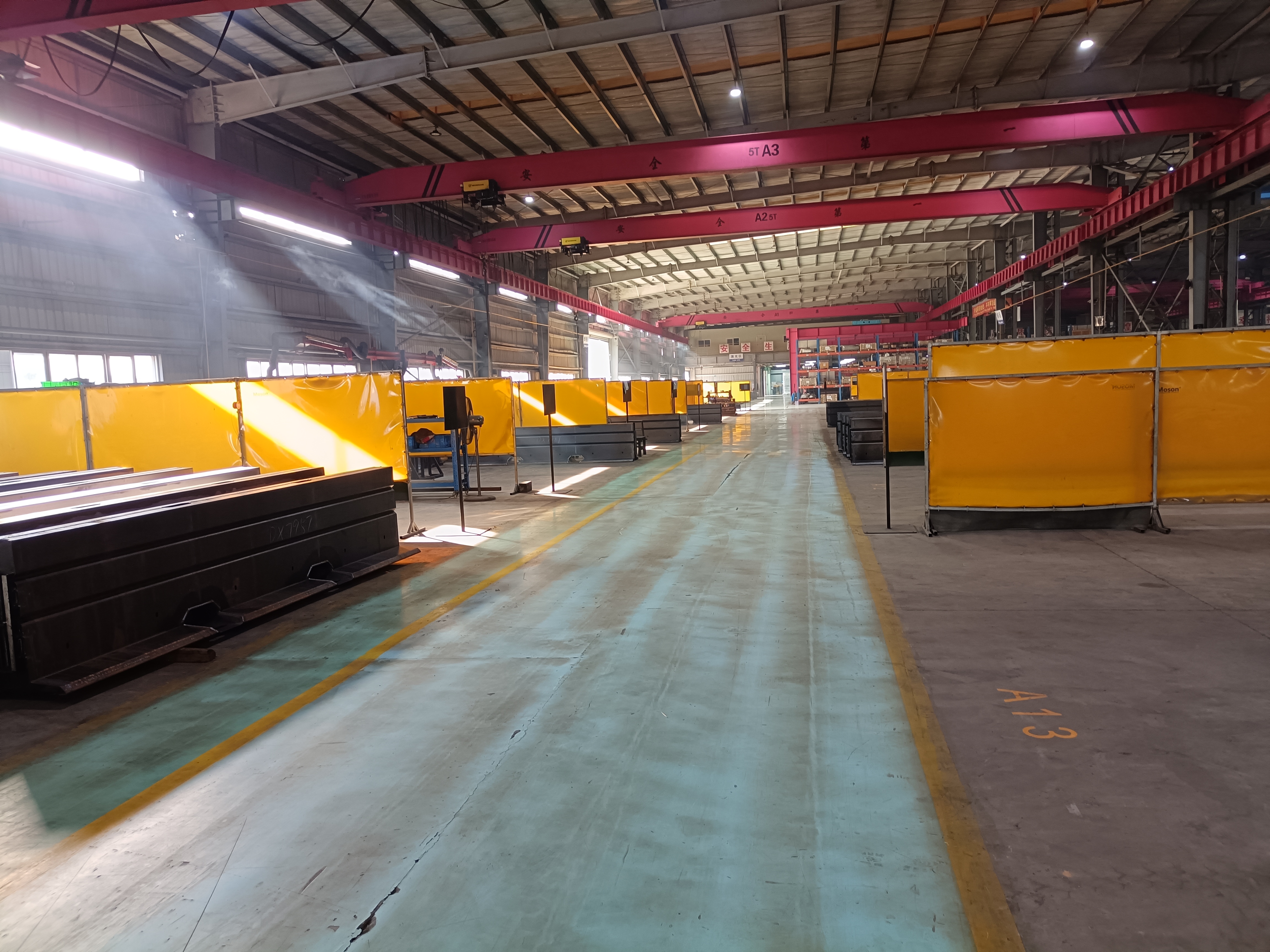
- Equipment identity. Ask for photos or short clips in which machine nameplates and capacity plates are legible, with the part you are buying in view. Capacity statements become checkable this way: overhead cranes above 250 t, bending equipment above 18 m in length and 10,000 t in tonnage, CNC travel up to 50 m × 8 m × 7 m, and a Zeiss CMM with 7 × 4 × 3 m measuring capacity.
- Process identity. Ask for an unedited walk-through video from gate to the relevant work centre, showing the welding cells, the forming area and the inspection room in one continuous take.
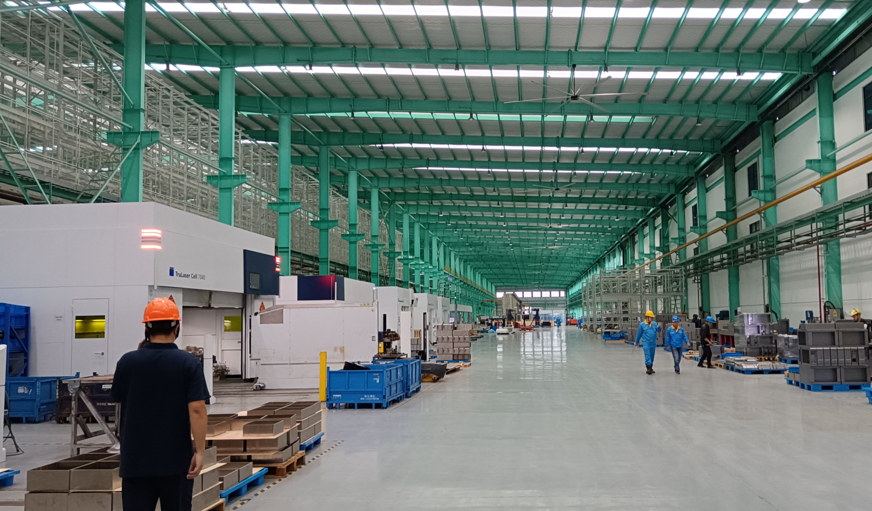
A second fabrication shop near Shanghai Port: site identity, equipment identity and process identity should all be checkable against the same legal entity.
None of this proves your specific part will be made on that floor. It does establish whether a floor exists, whether it holds the equipment claimed, and whether the entity holding the certificate is the entity quoting.
Step 2 — Read certificates for scope, standard and expiry
A certificate is only useful when three fields are read. The first is scope wording. Openex's ISO 9001 certificate (11426Q01049R001, GB/T 19001-2016 / ISO 9001:2015, issued 16 April 2026 by Beijing East Allreach Certification Center, valid to 15 April 2029) covers "manufacture of machined parts, metal structures and sheet metal components (except where a license is required)". That wording supports sheet metal and structural work; it does not confer a pressure-vessel licence, which is a separate qualification.
The second field is standard and process. A quality-management certificate is not a welding qualification. Openex holds ISO 3834-2 certification (23/999-3834, issued by SGS on 15 October 2024) for fusion welding of metallic materials, covering welding process 135 and 135-Auto and material groups 1.1 and 1.2. If your drawing calls for a different process or material group, that certificate does not cover the work.
The third field is the one buyers skip: the expiry date. The ISO 3834-2 document above carries a stated expiry of 4 October 2026, so a buyer reading it now should request the renewal rather than accept an out-of-date PDF — and should apply the same test to every supplier on the shortlist. Openex also holds ISO 14001 (11426E00739R001) and ISO 45001 (11426S00656R001) certificates issued 16 April 2026 and valid to 15 April 2029, both scoped to machined parts, metal structures and sheet metal components.
Two habits make this check reliable: open the certificate file rather than the badge on a website, and compare the certificate holder's legal name with the name printed on the purchase order.
Step 3 — Test the quoting path with your own drawings
Drawing handling is a fast, low-cost capability test, because it shows whether the supplier engineers the job or merely prices it. Openex accepts STEP, IGES, DWG, DXF, PDF and other 2D and 3D formats. For simple parts, 2D drawings alone are usually enough to quote; 3D models alone rarely are, because the 2D sheet carries information the model does not: tolerances, welding requirements, surface roughness and chamfer notes, cutting direction relative to the rolling direction, plate bend radius, material grade, heat-treatment and stress-relief instructions, and finish requirements such as hot-dip galvanizing, blasting and painting, or powder coating.
Most suppliers quote quickly when 2D and 3D drawings arrive together — in some cases within one or two hours. Use that. Send an identical drawing pack to every shortlisted fabricator, then compare response time and, more tellingly, the number of engineering questions returned. A fabricator asking about weld symbols, bend relief or post-weld machining is reading the drawing; one that returns a price without a single question is guessing.
Step 4 — Settle MOQ, sample and commercial terms before comparing price
MOQ in custom fabrication is project-based rather than a catalogue number, and the reason is arithmetic rather than policy. Full-container loading costs less per unit than LCL; fixed overhead spreads across a larger quantity; material can be bought at a better price in larger lots; and repeat orders keep both price and quality stable. Openex's stated position follows that logic: very small parts in very small quantities are a poor fit for a China-based custom fabricator, large parts in container-sized quantities are workable, and large parts in large quantities are the preferred profile.
Prices that look comparable often are not. Confirm the delivery term before ranking quotes, because EXW, FOB, C&F, CIF, DAP and DDP shift freight, insurance and import responsibility in different directions. Confirm the payment route as well — T/T or L/C — since it affects cash flow and, indirectly, the production slot you are given.
On samples, get the terms in writing instead of relying on a verbal yes: sample quantity, whether it is charged, the lead time, and which inspection record travels with it. A sample without a dimensional report only proves the supplier can make one part; a sample with a report proves the measurement loop exists.
Step 5 — Put acceptance criteria in writing
The last step before an order is to decide who declares the goods acceptable. Openex offers three documented routes: A, inspection by the fabricator with photos, videos and QA sheets submitted; B, inspection by the buyer or the buyer's representative; C, inspection by a third party appointed by the buyer. Choose one and name it in the purchase order — an unstated acceptance route becomes a dispute later.
Attach the inspection content to that choice. The available regime is 100% inspection or random testing as the requirement specifies, supported by non-destructive methods (RT, UT, MT, PT, VT and LT), destructive checks such as chemical analysis, tensile, impact including low-temperature testing, bend and hardness testing, salt-spray corrosion testing, and weld procedure qualification to the customer's WPS, plus dimensional and surface measurement including roughness parameters. For large fabrications, a Zeiss CMM with 7 × 4 × 3 m capacity allows full-size verification rather than a layout on a surface plate.
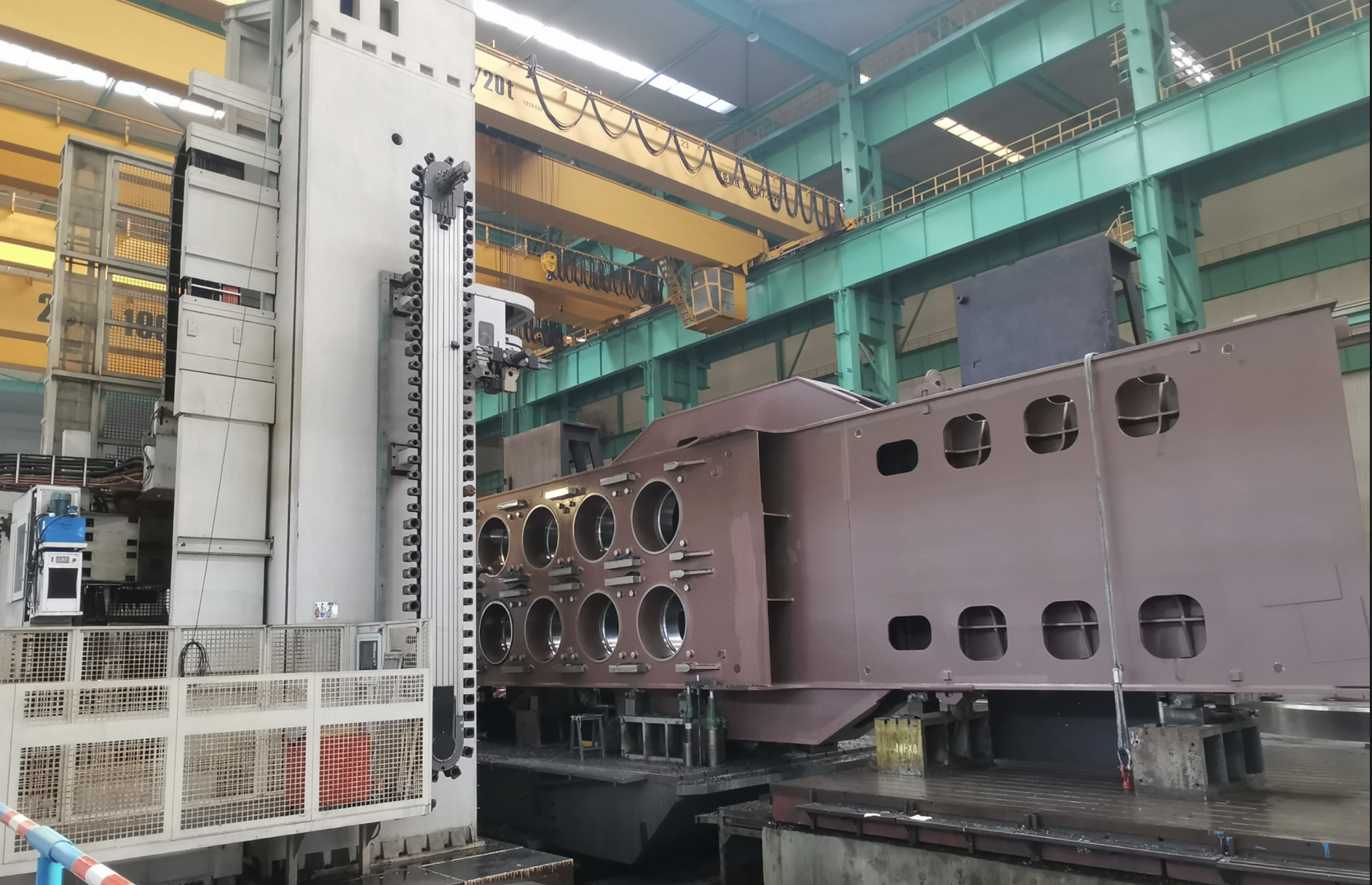
Post-weld machining capability is what decides whether a welded chassis or frame can hold a tolerance after distortion — ask for it as a named process, not a general claim.
What a usable delivery record must contain
Delivery assurance is argued from records, not adjectives. A record worth counting should state the part family and how close it is to yours, the destination market, the quantity shipped, the start of supply and the production rhythm, the operating duration, the reported condition, and a route to confirm it — an inspection report, a shipping document, or a reference contact.
Keep two durations apart. Years of supply tell you the relationship survived; years in service tell you the parts did. A ten-year supply relationship built on a design replaced every eighteen months is not long-life evidence. A single batch that has run for a decade in a steel mill is.
Four delivery records, read for different risks
| Application | Market | Quantity | Recorded timeline | Reported status |
|---|---|---|---|---|
| Steel-mill coil chassis (steel pallets) for coil and bar handling | Japan | 30 units | 30 years recorded; 20 years of stable operation | Still handling coils out of the rolling line |
| AGV steel chassis for containers and large loads | Netherlands | 345 units | More than 4 years of stable operation | Chassis in service in container yards |
| ESS steel frames and boxes for battery modules | Global | 3,000 units | Service-life figure of 20 years plus | No rust, no leakage, no deformation reported |
| Chain conveyors for a lithium-battery production line | Global | 120 units | 15 years plus service-life figure; 2 years stable operation | Conveyors running in the battery line |
Read together, the four records cover different failure modes. The Japanese steel-mill programme is the ageing evidence: low-volume, heavy-duty chassis built to store and tranship steel coils, with a supply relationship measured in decades and roughly 20 years of reported stable operation in a plant where a failed pallet stops a rolling line.
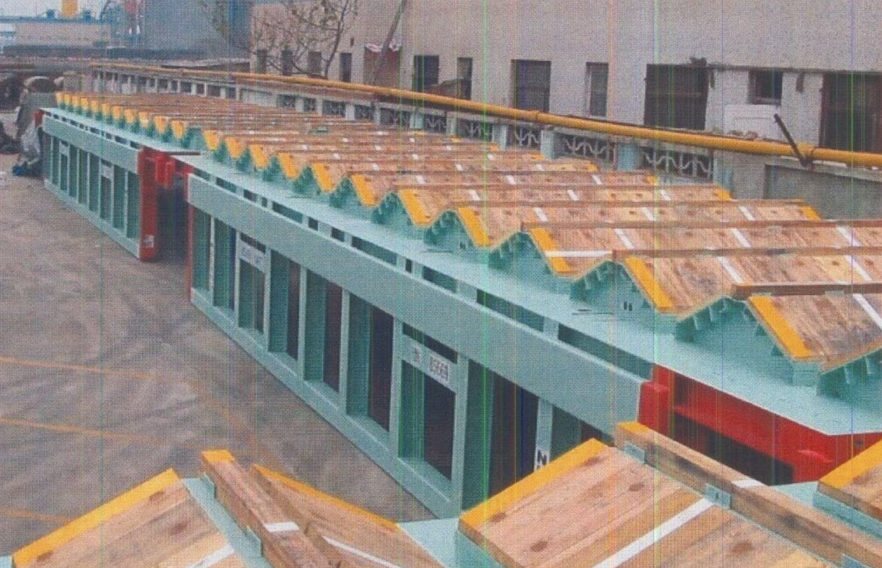
Steel coil chassis finished before shipment to a Japanese steel mill: the wooden pads on the V-shaped top protect the coil surface.
The Dutch programme is repeatability at moderate volume: 345 AGV steel chassis built to carry ocean-going containers or LNG tanks, shipped by bulk carrier, with more than four years of reported operation. Quantity in the hundreds tests fixture consistency, weld repeatability and packing — none of which a one-off build exercises.
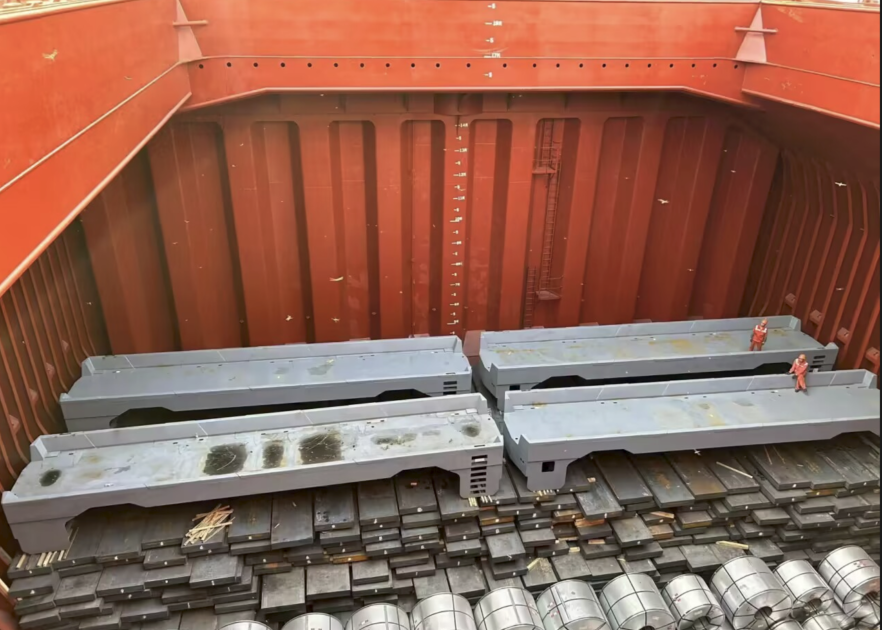
AGV steel chassis loaded for export: oversized weldments require breakbulk shipping experience, not only fabrication capacity.
The ESS record is volume plus consistency: 3,000 steel frames and boxes for battery modules, a service-life figure of 20 years plus, and a reported condition of no rust, no leakage and no deformation. For a buyer sourcing racks and cabinets for energy storage, corrosion and dimensional stability after assembly into a container are the two failure modes that matter, and this is the record that speaks to them.
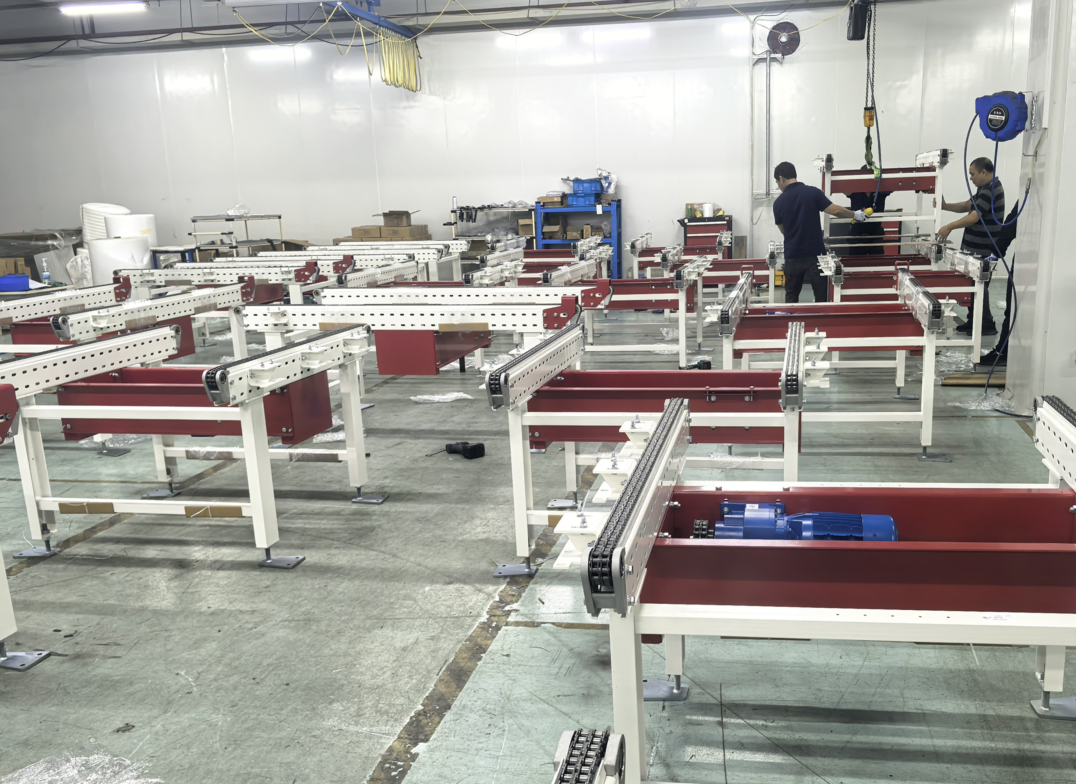
The 120 chain conveyors for a lithium-battery production line are the shortest record of the four — two years of stable operation against a 15-year-plus service-life figure. That is worth stating plainly: two years proves the build, the assembly and the handover worked; it does not yet prove a fifteen-year life. Where a supplier's record is short, ask for the assembly and inspection data supporting the longer claim, and price your own incoming inspection accordingly.
Evidence map: what each document proves, and what it does not
| Supplier claim | Document or check to request | What it establishes | What it does not establish |
|---|---|---|---|
| "We are a manufacturer" | Unedited workshop video with legible machine plates; site address matching the quoting entity | That the claimed equipment exists at a named site | That your part will be made there rather than subcontracted |
| "We are ISO 9001 certified" | Certificate file showing number, standard, scope wording, issuing body and expiry | A certified management system inside the stated scope | That your tolerances are achievable, or that the document is still valid |
| "We quote fast" | One identical 2D plus 3D drawing pack sent to every shortlisted supplier | Responsiveness and engineering reading on your own data | That the price is accurate or capacity exists at peak load |
| "Low MOQ, samples welcome" | Written MOQ basis, sample quantity, sample charge, sample lead time | A commercial starting point in writing | That sample pricing or timing will hold at production volume |
| "Long-life customers" | Project reference: quantity, market, start of supply, operating duration, condition report | That a comparable track record exists | That your design will reach the same service life |
| "We inspect 100%" | Inspection plan, sampling rule, NDT methods, CMM capacity, one sample QA sheet | The inspection regime and the record format you will receive | That every unit will be defect-free |
Use the map as a scoring sheet. For each supplier, mark whether the document was supplied, whether it was verifiable, and what it left unresolved; the unresolved column usually decides the shortlist.
Where Openex fabrication is not the right fit
An evaluation is only useful when the exclusions are explicit. Openex states that a project requiring only casting, forging or anti-rust finishing is not a good fit, because those processes run at partner plants; the value of the internal route lies in fabrication plus machining plus assembly, not in single-process sourcing. Very small parts in very small quantities are also uneconomic for a China-based custom fabricator once communication, travel and freight are counted.
Buyers who cannot supply 2D drawings face a slower path as well, since 3D-only packages need drawing creation and approval before a firm price can be issued. None of these limits is unusual for a custom fabricator; they simply decide which shortlist a project belongs on.
A ten-day evaluation sequence
- Day 1 — Request the pack. Site addresses, certificate files with scope and expiry, equipment list with capacities, and the in-house versus partner process split.
- Day 2 — Cross-check identity. Compare legal names across quotation, certificates and site addresses.
- Day 3 — Send drawings. One 2D plus 3D pack to every shortlisted supplier; log response time and the questions returned.
- Day 4 — Normalise commercial terms. Compare MOQ basis, delivery term and payment route at equal scope.
- Day 5 — Fix acceptance. Choose route A, B or C and name the inspection record you will receive.
- Day 6–8 — Sample or first article. Review the dimensional report and finish check, not only the part.
- Day 9 — Verify references. Quantity, market, operating duration and reported condition.
- Day 10 — Order with the evidence pack annexed. Attach the agreed inspection plan to the purchase order.
Conclusion
The manufacturer question and the delivery question need different evidence, and a shortlist built on only one of them will fail at a predictable point. Factory addresses, legible equipment plates, certificate scope and expiry, drawing-format handling, MOQ logic and a named acceptance route establish whether the supplier can make the part and whether the order can be closed cleanly. Quantity-specific records with dates — 30 steel-mill chassis with 20 years of stable operation, 345 AGV chassis in the Netherlands, 3,000 ESS frames and boxes, 120 chain conveyors for a battery line — establish whether the supplier has done it repeatedly and for how long. Where the record is short, say so and inspect accordingly; that is more useful than a longer list of adjectives.
Next step
If this checklist matches how your project is being evaluated, the fastest test is a drawing-based quotation. Send a 2D and 3D pack to sales2@openex.com.cn or reach the team on +86 150 6078 7506 (WhatsApp on the same number); the company profile, process list and equipment capacities are collected in the downloadable catalogue linked at the end of this page.
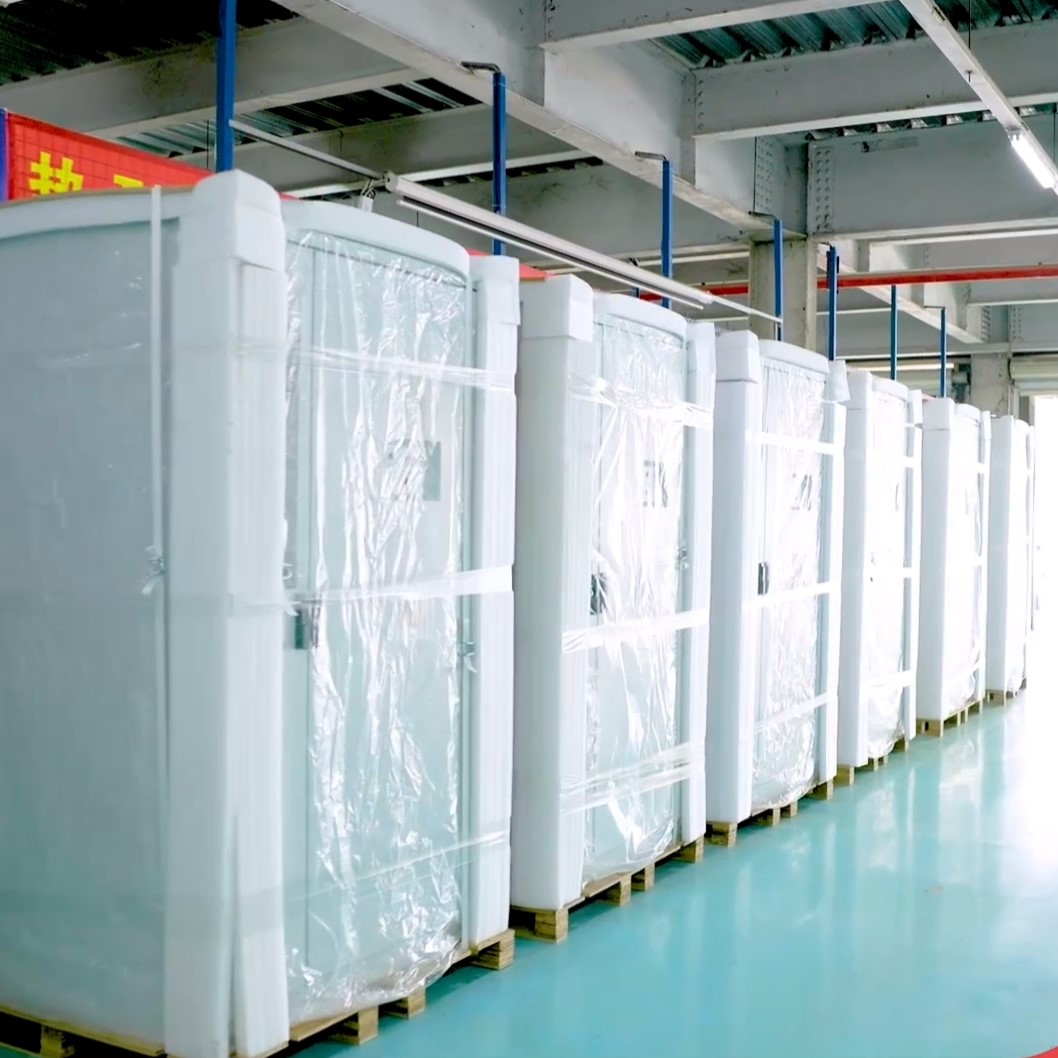
Packed battery cabinets awaiting shipment: packaging and loading records belong in the evidence pack you keep for each supplier.
Download the Openex fabrication catalogue (PDF) for the full process and equipment reference.
Frequently asked questions
How do I confirm that an OEM sheet metal fabrication manufacturer can actually make custom metal parts?
Request four things and check them against each other: the street address of each premise, an unedited workshop video showing legible machine nameplates, certificates whose scope wording covers sheet metal components, and a quotation returned against your own 2D and 3D drawings. Cross-checking the legal entity name on the quotation, the certificate and the site address is what separates a manufacturer from a quoting office.
Are you a manufacturer or a supplier, and can you provide factory photos, workshop videos and certificates?
Openex fabrication is a metal fabricator with two manufacturing premises, one near Xiamen Port and one near Shanghai Port, producing 80–90% of the metal parts, components and assemblies it exports in-house; the balance is sourced from partners. Factory photos and workshop video are available on request, together with ISO 9001, ISO 14001 and ISO 45001 certificates valid to 15 April 2029 and an ISO 3834-2 welding certificate whose stated expiry is 4 October 2026.
What metal materials can you process for our fabrication projects?
Fabrication is possible across metals, including brass, bronze and aluminium, with carbon steel and stainless steel the most common. In carbon steel the frequently used families are Q235B (A36, SS400, S235JR) and Q355B (A572 Gr50, SS490/SPCC, S355JR), with Q690 and NM450/NM500 also handled; in stainless steel, SUS 304 and SUS316L dominate. Where a project needs a special casting or forging grade, long-term partner plants supply it.
What drawing formats do you accept?
STEP, IGES, DWG, DXF, PDF and other 2D and 3D formats are accepted. 2D drawings alone are usually sufficient to quote; 3D models alone rarely are, because the 2D sheet carries tolerances, welding requirements, surface roughness and chamfer notes, cutting direction relative to rolling direction, bend radius, material grade, heat-treatment and finish requirements. Sending both normally produces the fastest quotation.
What is your MOQ, and can I order samples before mass production?
MOQ is project-based rather than a fixed figure, because container loading, overhead spreading, material purchasing and repeat ordering all change the economics. Very small parts in very small quantities are not economic for a China-based fabricator; large parts at container-sized quantities are workable; large parts in large quantities are preferred. Sample terms — quantity, charge, lead time and the inspection record supplied with it — should be agreed in writing before the production order.
What are the purchasing terms and acceptance criteria?
Delivery terms offered are EXW, FOB, C&F, CIF, DAP and DDP, with payment by T/T or L/C. Acceptance follows one of three routes: A, inspection by Openex with photos, videos and QA sheets submitted; B, inspection by the buyer; C, inspection by a third party appointed by the buyer. Choosing a route early keeps the inspection plan, the shipping documents and the price comparable across suppliers; drawing packs and catalogue requests can be sent to sales2@openex.com.cn.
Have Questions or Need More Details?
Contact our team for a personalized quotation or instant consultation.
Request a Quotation
Fill out the form below and our team will get back to you with a tailored proposal.
WhatsApp Direct Chat
Prefer to chat in real-time? Message us on WhatsApp for instant assistance & quick answers.
- Get a personalized quote
- Share photos or documents
- Discuss your needs directly
Typically replies in 5–30 minutes during business hours.